
Is the Dragon Tree Houseplant Suitable for the Bedroom? – The Big air-Q Test!
The myth that houseplants don't belong in the bedroom persisted for a long time. But this assumption has been disproven: there are plants that need little oxygen and even improve the indoor climate. In our air-Q Lab, we thoroughly tested three species and measured their effect on air quality. Today we introduce you to the dragon tree.
Good room air is a basic requirement for good sleep. But dry heating air, lack of air circulation, and off-gassing from furniture, wallpaper, and floors worsen bedroom air quality. Houseplants help here — especially succulent species.
Houseplants improve air quality
The special benefit of succulents is their air-purifying effect and, of course, their low maintenance needs. Some green species are especially well suited for this. Their leaves absorb toxins, neutralize them within their cells, and release purified oxygen back to the environment. Some plants can even absorb and convert pollutants like benzene, carcinogenic formaldehyde, or trichloroethylene. Besides this air purification, houseplants offer other positive properties for the indoor climate: they raise humidity and convert carbon dioxide (CO₂) into oxygen and biomass.
For our hands-on tests, our partner Feey — the online shop for houseplants provided us with three green houseplants: dragon tree, snake plant, and spider plant. In our air-Q Lab, we took a close look at these air improvers. Today we show you the test results for the dragon tree. Find the results for the snake plant here.
Why is the dragon tree especially well suited as a houseplant?
Like the other houseplants in our hands-on test, the dragon tree is also a low-maintenance houseplant that likes sun but also grows in partial shade or shade above 15°C. The African dragon tree filters many pollutants such as formaldehyde and benzene from the air.
The dragon tree houseplant in the air-Q Lab: our test results
In our air-Q Lab, we placed the dragon tree together with the air monitor in an airtight but transparent box about 50 cm high. To ensure sufficient light supply so the plant could also photosynthesize during the test, the box was placed near a window. We looked at how the data developed over a period of about 24 hours, letting us draw conclusions about air quality both during the day and at night. Throughout this time, the air-Q captured the air components. In our web application, we could then read off how they developed. The following readings were examined:
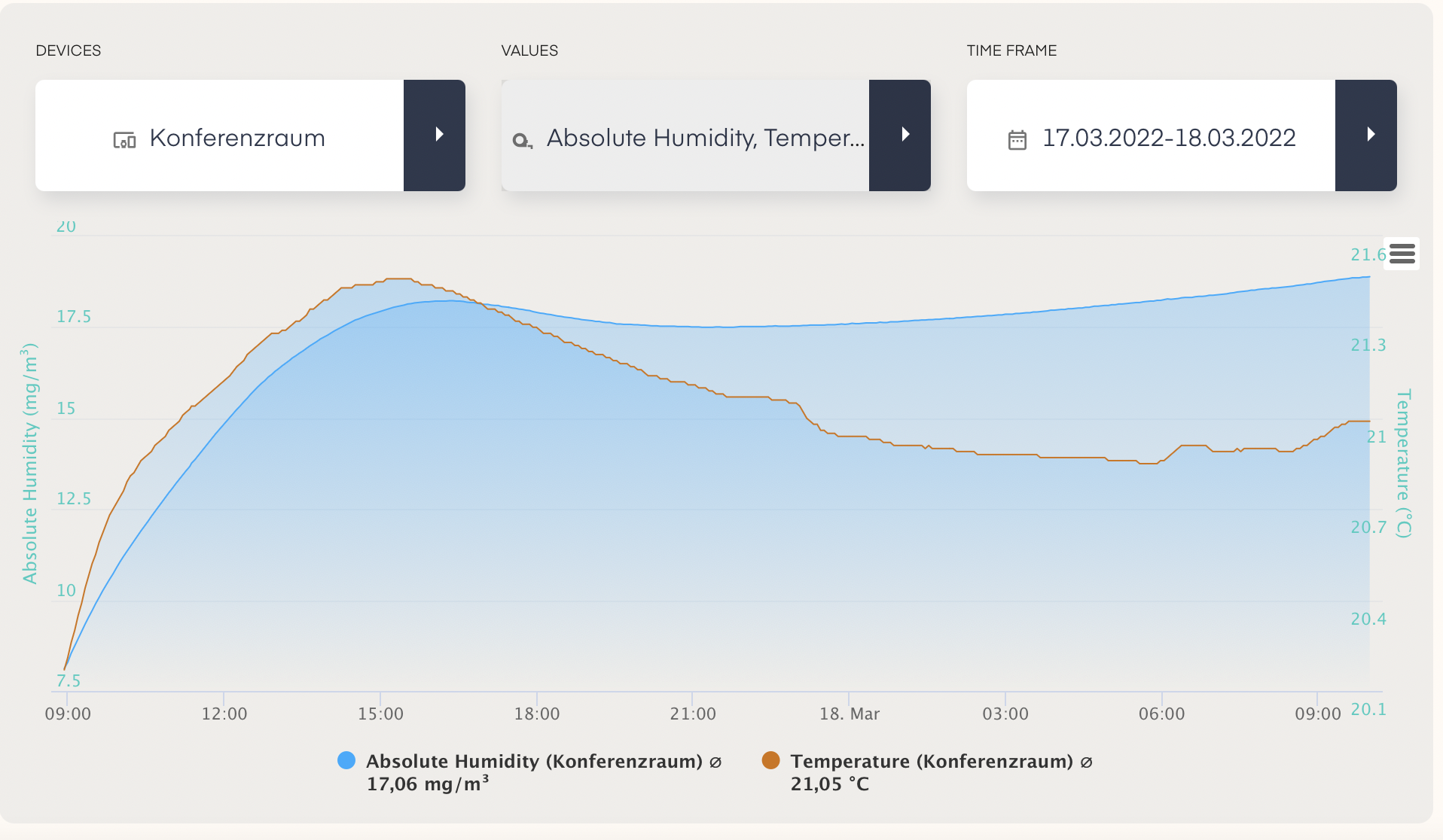
At the start of the test, all readings showed a normal level. As sunlight increased through the morning, temperature also rose steadily. In the afternoon, values of just under 22 degrees were measured in the box. After 3 p.m., temperature dropped and fluctuated between 20 and 21 degrees between 9 p.m. and 9 a.m. The average temperature during the test was 20.05 degrees. Similar to temperature, absolute humidity in the box also rose during the morning of the hands-on test. Also around 3 p.m., values reached a first peak of just under 18 mg/m³. So humidity increased by about 10 mg/m³ within six hours. In the early evening, the humidity value dropped somewhat, but rose again toward midnight and reached its second peak at the end of the test with just under 19 mg/m³. During the test, the air-Q recorded an average absolute humidity of 17.67 mg/m³.
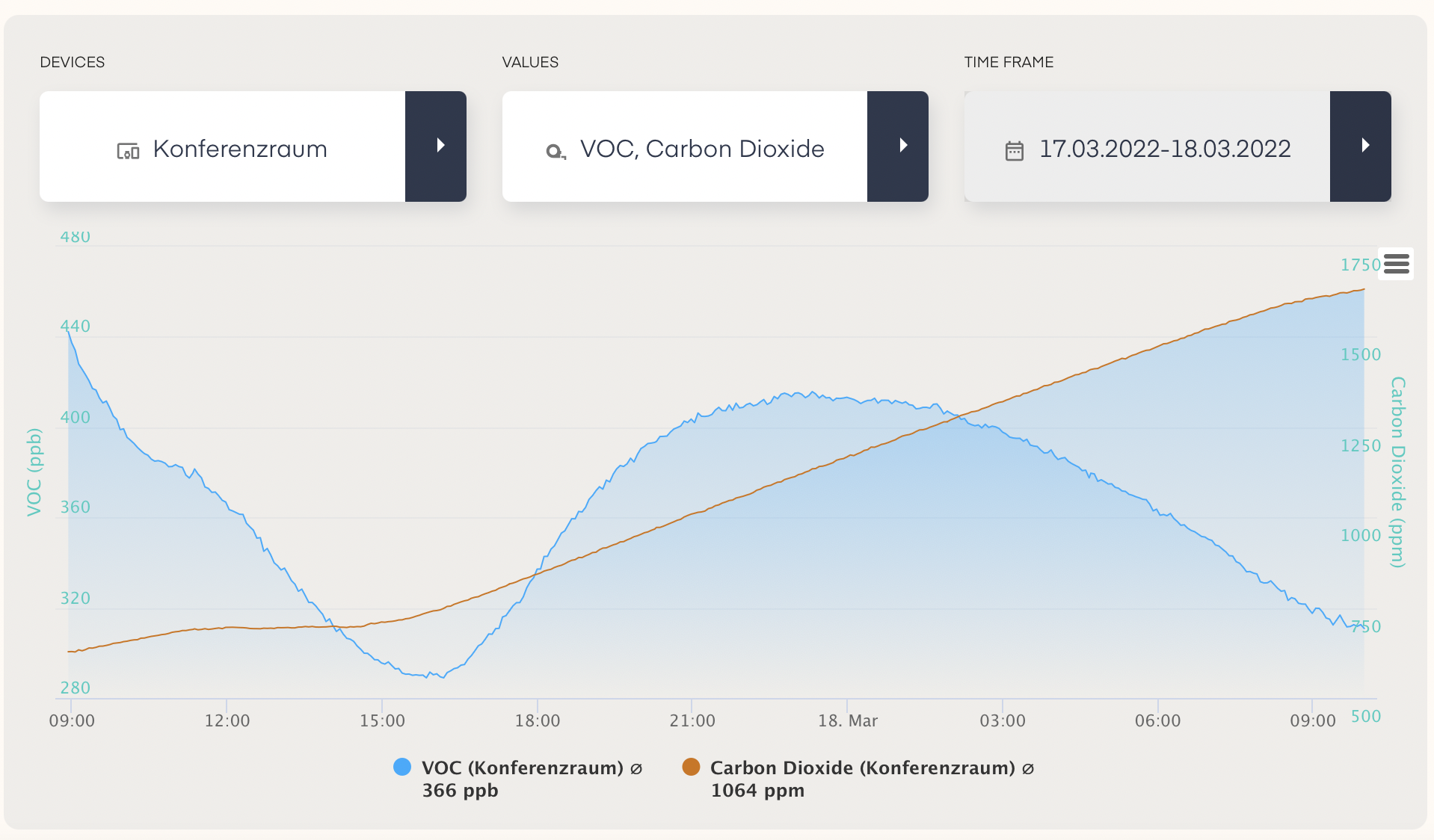
As in the test with the snake plant, we could also observe a steady rise in carbon dioxide concentration in the box during the test with the dragon tree. The reading curve resembles a rising line, nearly tripling from a starting value of about 600 ppm (parts per million) to a peak of about 1,700 ppm at the end of the test. We interpret these values as an indication that the plant produces oxygen very effectively and consumes extremely little oxygen even at night.
Besides humidity and carbon dioxide content, we also analyzed VOC concentration in room air. A concentration of 440 ppb was measured at the start of the test. These values halved within six hours, reaching a low of about 290 ppb around 3 p.m. By evening, though, the values rose again noticeably, nearly reaching the starting level again around midnight. By the end of the test at 9 a.m., VOC concentration dropped again, reaching just under 310 ppb, nearly matching the previous day's low again. From these results, a strong air-purifying effect of the dragon tree can be inferred.
In our video, you can follow our experiment in fast-forward.
Conclusion
The dragon tree has a very strong effect on room humidity. In our test, values rose by 125 percent. During the day, VOC values also dropped significantly, by 35 percent. We can therefore confirm that this houseplant very effectively reduces pollutants in room air. During the day, CO2 values in the box dropped by 64 percent. This suggests rising oxygen saturation in the box. We can therefore assume that the green plant, once it's photosynthesizing, produces oxygen very effectively. With these values, the dragon tree is ideal for the bedroom. You'll in no way compete with the plant for oxygen in room air. Rather, the houseplant contributes to good room air and supports healthy sleep. The dragon tree therefore demonstrably provides better air quality and is thus also excellently suited for your bedroom.
(Cover image: Canva)