
Do Closed Windows Protect Against Particulate Matter?
Exhaust fumes and more pollute our air, often exposing it to particulate matter. The very small diameter of the particles makes this dangerous. This lets the dust enter the airways and affect health. Do closed windows prevent particulate matter from entering a home? We measured it with our air-Q air quality monitor.
What is particulate matter?
Particulate matter consists of both solid and liquid suspended matter and is abbreviated as PM (particulate matter). Particle size varies: from ultrafine particles as small as just 1 µm up to 10 µm. You can tell the size from the number after the PM, meaning PM₁₀, PM₂.₅, or PM₁. Since even the "large" particulate matter particles are very small, they reach deep into the bronchi through breathing and can have a lasting effect on the body. The problem: allergens often attach to the particles, which can trigger or intensify allergies.
What health effects does excessive particulate matter exposure have?
Particulate matter particles irritate the respiratory system and can cause inflammatory changes. If the smaller particles even enter the bloodstream, they affect the cardiovascular system there and can increase the risk of heart attack. Other possible symptoms are irritation of the mucous membranes of the eyes, nose, and throat.
air-Q test: does particulate matter get through closed windows too?
Particulate matter enters indoor spaces through open windows or via shoes and clothing. Does keeping windows closed help keep particulate matter out? We checked this, measuring with the air-Q air quality monitor on New Year's Eve. That's because firing off rockets and similar fireworks releases enormous amounts of particulate matter: ideal conditions for a test.
We conducted the practical test on New Year's Eve in two different Leipzig neighborhoods: on one hand in our office in Plagwitz, a neighborhood away from the city center, and on the other in our colleague's apartment in central Leipzig. The annual major fireworks display took place in the center. In both spaces, the windows and doors were closed during the test measurement with the air analyzer, and no people were present.
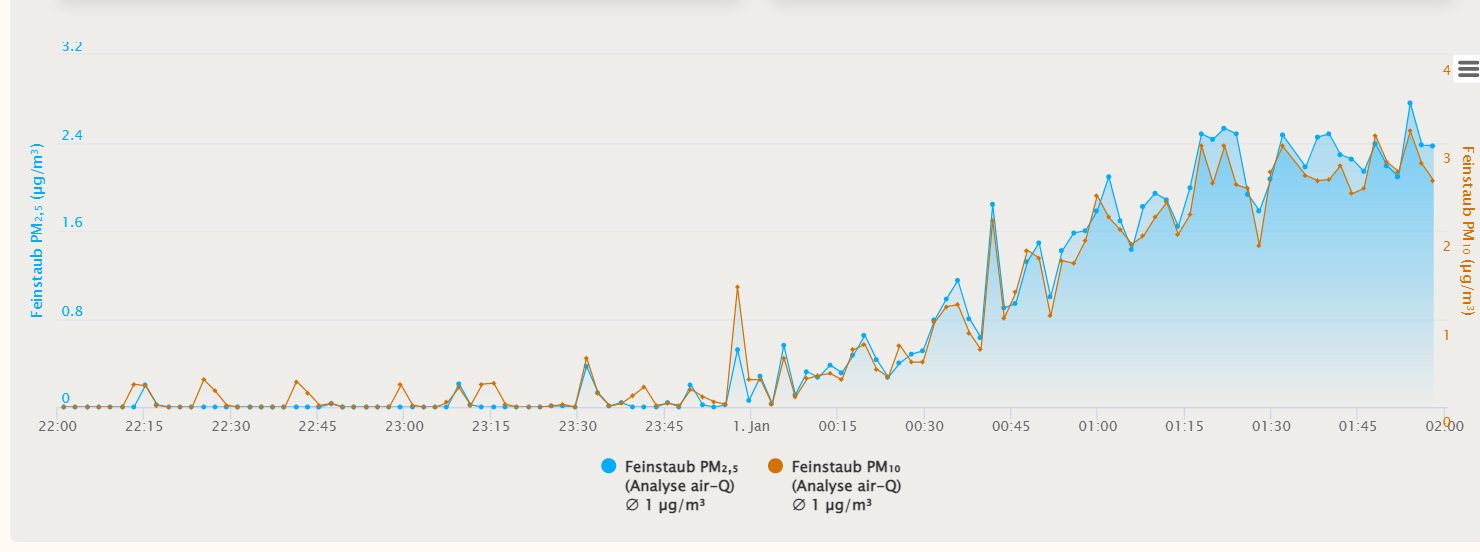
The air-Q test measurement in our office from 10 p.m. to 2 a.m. already shows isolated increases in particulate matter values before midnight. Starting from initial values of 0 PM, the air quality monitor was able to detect both larger particles (PM₁₀) and smaller particulate matter particles (PM₂.₅) within the first two hours. During this period, the air-Q shows harmless values of at most 0.5 μg/m³. After a short period of 10 to 15 minutes each, the values recover again and again. With the fireworks starting around midnight, however, PM concentration rises steadily. Despite some brief recovery phases, room air quality can't regenerate with the window closed. With maximum values of 3.2 μg/m³ for the larger particles and 2.8 μg/m³ for PM₂.₅, this represents an enormous increase in pollutant exposure in the room.
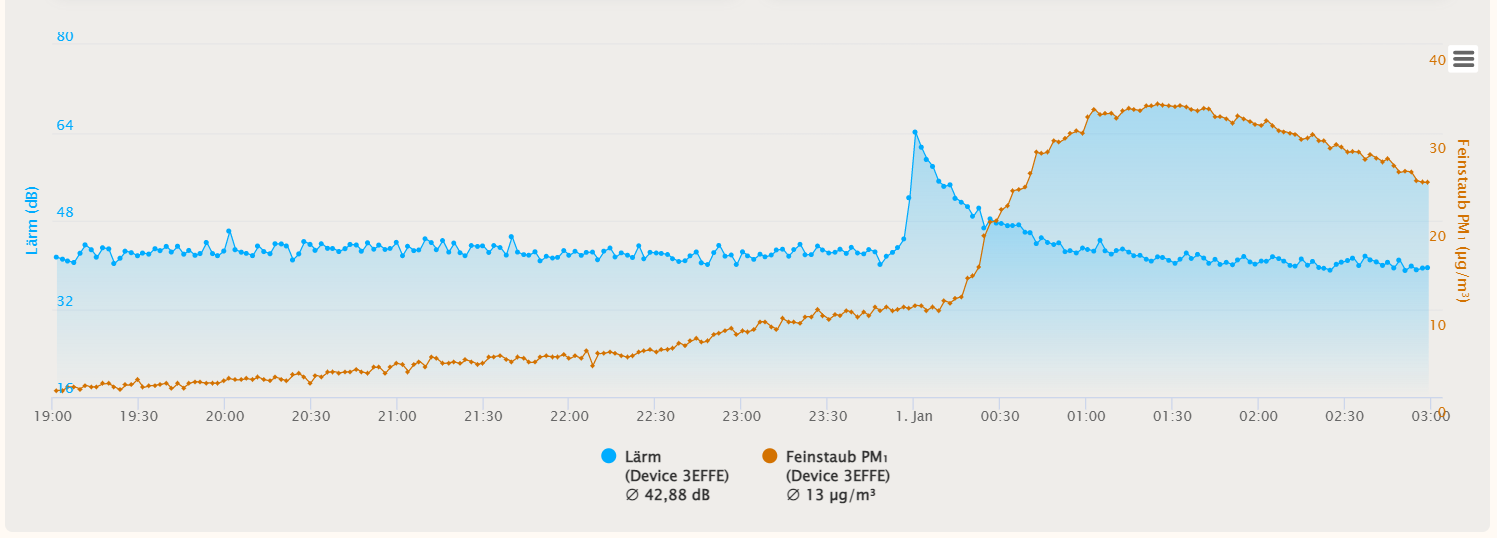
The test measurement in the private apartment in the city center took place between 7 p.m. and 3 a.m. Here, the initial values for particulate matter were already slightly elevated at the start of the test recording. Unlike the office measurement, air readings in the apartment couldn't recover in between, instead rising steadily. PM exposure thus already reached 10 μg/m³ before midnight. With the start of the fireworks, concentration jumps sharply and reaches its peak of about 33 μg/m³ around 1:30 a.m. For reference: according to the World Health Organization (WHO), the annual limit value for PM₂.₅ is 25 μg/m³.
Besides particulate matter, noise exposure was also measured. This fluctuates between 40 and 47 decibels between 7 p.m. and midnight. Around midnight, the maximum value of 64 dB is reached, then flattens out again slightly. Over the entire test period, the air-Q determined an average noise exposure of 42.88 dB. The limit values for indoor spaces are 35 dB during the day and 25 dB at night.
Conclusion
Our test measurement shows that particulate matter particles enter a home despite closed windows and significantly affect air quality there. Checking air components is therefore recommended.