
Invisible Danger: How Cigarette Smoke Pollutes the Air
Cigarette smoke contains pollutants that remain indoors for hours – even after smoking. Especially a risk for children and non-smokers. Our blog shows how the air-Q air quality monitor makes this exposure visible – and how you can effectively protect yourself.
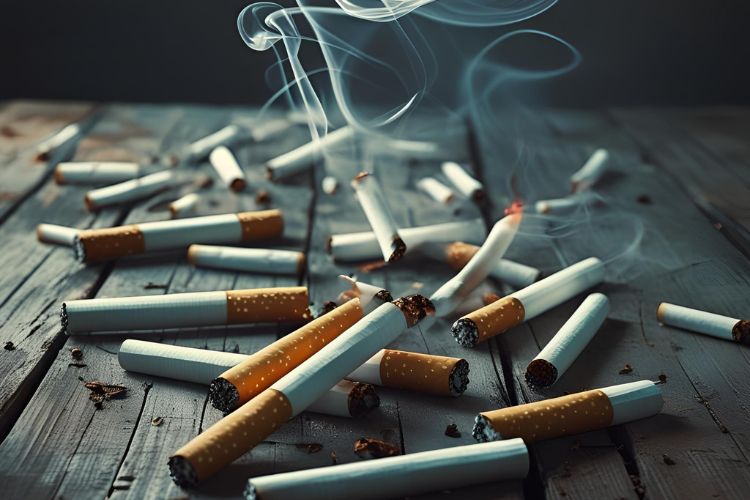
When smoking becomes an indoor hazard
The smell of cigarette smoke often dissipates quickly – but the harmful ingredients remain. What many don't know: even hours after smoking, fine particles, toxic gases, and carcinogenic substances are still measurable in indoor air. Secondhand smokers – i.e. everyone exposed to the smoke without smoking themselves – are especially affected. Modern air analyzers like the air-Q make these invisible dangers visible for the first time – helping you take targeted action.
-(300-x-250-px)-(1500-x-1300-px).jpg)
What smoking releases – and what that means for indoor air
Burning a cigarette produces over 4,000 chemical substances, including a large number of toxic, irritating, and carcinogenic substances. Many of these quickly spread through indoor air – exposing everyone present.
The key pollutants at a glance:
| Substance group | Examples | Health effect |
| Particulate matter (PM) | PM₁₀, PM₂.₅, PM₁ | Penetrates deep into the lungs & bloodstream, triggers inflammation |
| Carbon monoxide | Invisible, odorless | Blocks oxygen transport in the blood |
| Nitrogen dioxide | NO₂ | Irritant gas, damages the airways |
| VOCs | Benzene, nicotine, formaldehyde, acetone | Partly carcinogenic, irritating, neurotoxic |
| PAHs & metals | Lead, cadmium, benzo[a]pyrene | Heavy metals, strongly carcinogenic |
Secondhand smoke & particulate matter: when the cigarette becomes an air polluter
A single cigarette can drastically drive up indoor particulate matter levels. PM₂.₅ concentrations of over 1,000 µg/m³ have been measured in smoke-filled rooms – that's more than 60 times the WHO limit value (15 µg/m³ as a daily average).
In a small apartment, a single cigarette can be enough to exceed a full day's particulate matter exposure on a busy main road.
In smoking bars or on terraces with several smokers, values between 200–600 µg/m³ are regularly reached – often over the course of hours.
The air-Q measures particulate matter in real time (PM₁, PM₂.₅, and PM₁₀), detecting polluted rooms or time windows – even where it's not obvious at first glance.
VOCs in cigarette smoke: when nicotine & co. travel through the air
Cigarette smoke contains more than 250 different VOCs (volatile organic compounds) – including substances of high health concern such as:
- Nicotine (~150–300 µg per cigarette)
- Formaldehyde
- Benzene
- Toluene
- Acetone
An average analysis result for tobacco smoke in micrograms per cigarette
| Substance | Content (µg) | Substance | Content (µg) |
| Carbon monoxide | < 10 000 | Magnesium (ionized) | 0.07 |
| Nicotine | < 1 000 | Antimony (ionized) | 0.052 |
| Acetaldehyde | 500 … 1 200 | Pyrene | 0.05 … 1.01 |
| Hydrogen cyanide | 400 … 500 | Benzo[a]fluorene | 0.04 … 0.18 |
| Hydroquinone | 110 … 300 | Iron (ionized) | 0.042 |
| Acetic acid | 100 … 1 000 | o-Toluidine | 0.03 … 0.16 |
| Nitrogen oxides | 100 … 600 | Anthracene | 0.02 … 0.23 |
| Catechol | 100 … 360 | Benzo[b]fluorene | 0.02 |
| Acetone | 100 … 250 | Fluoranthene | 0.01 … 0.27 |
| Methanol | 90 … 180 | Hydrazine | 0.03 … 0.04 |
| Formic acid | 80 … 600 | Urethane | 0.02 … 0.04 |
| Formaldehyde | 70 … 100 | Lead (ionized) | 0.017 … 0.98 |
| Potassium (ionized) | 70 | Arsenic | 0.012 … 0.022 |
| Phenol | 60–140 | Dibenzo[a,j]anthracene | 0.01 … 0.03 |
| Ammonia | 50 … 130 | 1-Nitrosopyrrolidine | 0.006 … 0.11 |
| 3- and 4-Cresol | 40 … 80 | Benzo[a]pyrene | 0.005 … 0.078 |
| 3-Methylpyridine | 20 … 36 | Dibenzo[a,h]anthracene | 0.004 |
| Pyridine | 16 … 40 | Mercury | 0.004 |
| Nitrosamines (total) | ≤ 8.5 | Benzo[a]anthracene | 0.004 … 0.076 |
| N'-Nitrosonornicotine | ≤ 3.7 | 1-Methylchrysene | 0.003 |
| Sodium (ionized) | 1.3 | Benzo[ghi]perylene | 0.003 … 0.039 |
| Carbazole | 1.0 | Anthanthrene | 0.002 … 0.022 |
| Aluminum (ionized) | 0.22 | 4-Aminobiphenyl | 0.002 … 0.005 |
| N'-Nitrosoanatabine | 0.2 … 4.6 | Vinyl chloride | 0.001 … 0.01 |
| 2-Nitropropane | 0.2 … 2.2 | N-Nitrosodiethylamine | 0.001 … 0.02 |
| Copper (ionized) | 0.19 | Silver | 0.0012 |
| Zinc (ionized) | 0.12 … 1.21 | Gold | 0.00002 |
| Phenanthrene | 0.08 … 0.62 | Chromium | 0.004 |
Source: Tobacco smoke – Wikipedia
Many of these substances vaporize as the cigarette smolders and accumulate in indoor air – even with a window open.
The air-Q measures VOCs as a TVOC value (Total Volatile Organic Compounds), enabling a qualitative and quantitative analysis of pollutant exposure from cigarette smoke.
CO & NO₂: invisible gases, major danger
Two especially dangerous gases in cigarette smoke are:
- Carbon monoxide (CO): Colorless and odorless, but extremely dangerous. Already critical starting at 10 ppm – often measurable at 30–50 ppm in smoke-filled rooms.
- Nitrogen dioxide (NO₂): An irritant gas that attacks mucous membranes and the lungs. Peak values while smoking: over 200 µg/m³, although 40 µg/m³ is already considered harmful to health.
With the air-Q pro, both gases can be precisely captured in real time – for clear insight where health hazards otherwise go undetected.
Symptoms of secondhand smoke exposure: noticeable and silent risks
It's not just the air that gets worse – the body suffers too. The symptoms and risks of secondhand smoke exposure are varied:
| Time frame | Possible effects |
| Short-term | Irritation of eyes, nose & throat, coughing, headaches |
| Medium-term | Worsening of asthma, bronchitis, more frequent infections |
| Long-term | Increased risk of lung cancer, cardiovascular disease, strokes, childhood asthma |
Protective measures: what really helps against secondhand smoke
Here's how you can effectively reduce exposure:
- Smoking ban indoors – even with the window tilted open
- Use outdoor areas for smoking
- Intensive cross-ventilation instead of a permanently tilted window
- Air purifiers with activated carbon filters – helpful against some VOCs, but not against all substances
- Air quality measurement with the air-Q – for an objective assessment and targeted decisions
The air-Q makes secondhand smoke visible
With the air-Q, you can measure air quality where it matters – whether in the nursery, living room, office, or car. Especially helpful: real-time data on:
- TVOC (total VOC)
- PM₁ / PM₂.₅ / PM₁₀ (particulate matter)
- Carbon monoxide (CO)
- Nitrogen dioxide (NO₂)
This lets you immediately detect exposure spikes from smoking – and take targeted measures.
Making what makes you sick visible
Cigarette smoke isn't just an odor problem – it's a serious health risk. Even for non-smokers. With an air quality monitor like the air-Q, you can make invisible pollutants visible – and make informed decisions for a healthier indoor climate. For more clarity, more protection, and, in the long run, more health.