
How Candles, Christmas Trees, and Holiday Decor Affect Our Indoor Air, and How the air-Q Can Help
Candles, fir trees, and Christmas decor create a festive mood but often burden indoor air. Learn how particulate matter, VOCs, and CO₂ can rise during the Advent season and how the air-Q makes exposure visible so you can keep air quality effortlessly under control.
Why the festive season affects indoor air
For many, the Christmas season is the most wonderful time of year. Candlelight, the scent of fir trees, and festively decorated rooms create an incomparable atmosphere. But while we enjoy the coziness, we often forget that these traditions can also affect our indoor air quality. Especially in the cold winter months, when windows mostly stay closed, particulate matter, volatile organic compounds (VOCs), and other pollutants build up in our homes.
Candles and particulate matter: an invisible burden during Advent
Candles are among the biggest sources of particulate matter indoors. Burning paraffin or stearin candles produces ultrafine particles that can penetrate deep into the lungs. Scented candles or candles with dyes additionally release VOCs that can cause respiratory irritation. Especially in small or poorly ventilated rooms, using several candles for hours can noticeably increase exposure. Anyone who switches to LED candles or natural beeswax or soy wax candles significantly reduces exposure without having to give up coziness.
-(300-x-250-px)-(1500-x-1300-px).jpg)
Christmas tree and decor: how natural and artificial materials affect air quality
The Christmas tree itself also affects air quality, though in a different way. Fresh fir and spruce trees release essential oils and terpenes that create the typical pine scent. While these substances can smell pleasant, they react chemically with ozone in the air and form secondary substances like formaldehyde, which burden indoor air. In addition, a real tree, especially if it stands for a long time or was already damp before being set up, can bring dust, pollen, or mold spores into the room. Artificial Christmas trees, on the other hand, release small amounts of VOCs from plastic when exposed to warmth or sunlight, though these are usually within a harmless range.
Christmas decorations made of fabric, plastic, or other materials also contribute to air pollution. Fabric garlands, wreaths, or old decorations can collect dust and mites, which get stirred up when moved or cleaned. Plastic items or heavily scented decor release volatile substances that can affect air quality. Fragrance oils or room scents further amplify this effect and can cause irritation.
-(1).png)
How the air-Q helps: monitoring indoor air during the holidays
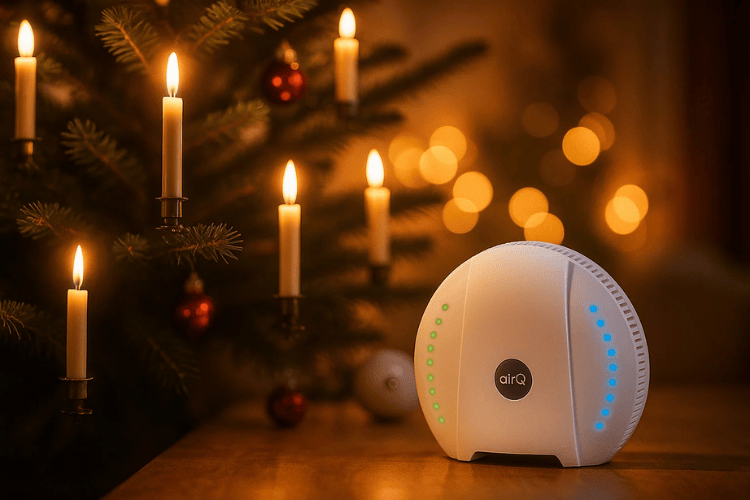
How can you improve air quality during the festive season without giving up candles and decoration? This is where the air-Q comes in. With its precise sensors for particulate matter (PM1, PM2.5, PM10), VOCs, CO₂, temperature, and humidity, the air-Q enables continuous monitoring of indoor air. Users can see in real time how candles, Christmas trees, or fragrance oils affect air quality and take targeted action.
In addition, the air-Q offers smart analyses and individual recommendations to keep indoor air healthy. This way, allergy sufferers, asthmatics, or sensitive individuals can make sure that festive decorations and candles don't permanently burden the air. With air-Q's data, you can see which measures actually work and how air quality changes over the course of the winter weeks.
Festive mood without bad air
Christmas and good air quality don't have to be mutually exclusive. Anyone who handles candles, trees, and decoration consciously and regularly checks the air can enjoy the festive mood without endangering their own health or that of their family. With air-Q, the invisible risk becomes visible, and the air within your own four walls stays clean and healthy.