
Air Quality Worldwide: How Germany Compares
Air quality is crucial for our health — from respiratory complaints to cardiovascular disease. The following article shows how Germany stacks up in a global comparison and where action is still needed.
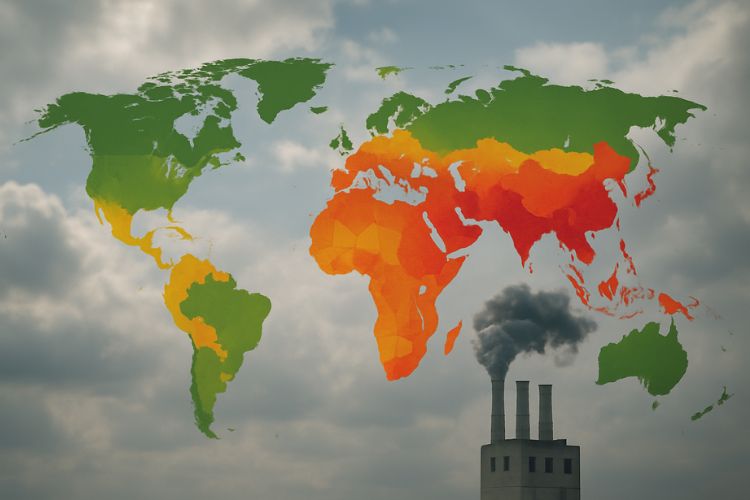
Germany performs well on air quality in a global comparison, especially compared to heavily polluted countries in Asia or Africa. Still, despite progress, particulate matter and nitrogen dioxide levels remain above the stricter WHO guidelines. Improvements since 2000 are attributable to the energy transition, emissions standards, and environmental regulations, but further measures — such as expanding public transit, cycling infrastructure, and low-emission vehicles — are needed. So the air in Germany is cleaner than in many countries, but it doesn't yet meet WHO standards.
Air quality worldwide — and where Germany stands
The quality of the air we breathe has an enormous effect on our health. Respiratory disease, cardiovascular problems, and millions of preventable deaths each year are directly linked to air pollution. But what's the situation worldwide — and where does Germany stand in comparison?
Worldwide differences
According to the World Health Organization (WHO), about 99% of the world's population lives in regions where air pollution exceeds WHO thresholds (WHO, 2023). Countries in Asia and Africa are especially affected.
- Asia: in cities in India or Pakistan, particulate matter readings (PM₂.₅) are often more than ten times higher than WHO guidelines.
- Africa: besides industry, Saharan dust also contributes to high pollution levels.
- North America & Oceania: strict environmental regulations result in comparatively clean air here.
- Europe: generally better, but metropolitan areas with heavy traffic often significantly exceed WHO recommendations.
A current report shows: only seven countries worldwide actually comply with WHO guidelines for particulate matter — including Australia, New Zealand, and a few small European states (IQAir / The Guardian, 2025).
How does Germany compare?
Germany stands solidly in a global comparison — but you can't call the air clean.
- Particulate matter (PM₂.₅): according to the German Federal Environment Agency (UBA), Germany was for the first time entirely within EU thresholds in 2022. Yet almost the entire population is still exposed to levels above the stricter WHO guidelines (UBA, 2022).
- Nitrogen dioxide (NO₂): major cities like Munich, Stuttgart, or Berlin were long problem areas. In 2024, though, all EU thresholds were met for the first time (UBA, 2024).
- Trend: readings have continuously improved since 2000, thanks to the energy transition, emissions standards, and stricter environmental regulations. Still: the air doesn't yet meet WHO standards.
What's left to do?
Even though Germany is making progress, a lot of work remains:
- Stronger promotion of public transit, cycling, and walking.
- Accelerated transition to low-emission vehicles.
- Further reduction of industrial and energy emissions.
Why does the air-Q make sense?
- Early warning: real-time monitoring of sensitive PM₂.5 readings helps immediately when changes occur.
- Regional insights: distinguishing between city and countryside improves environmental measures.
- Integration: smart alerts support citizens and cities in air quality management.
With smart measuring devices like the air-Q, air quality becomes visible — and we can act in time.
-(300-x-250-px)-(1500-x-1300-px).jpg)
Conclusion
In a global comparison, Germany stands well — significantly better than, say, India or Egypt. But we too don't breathe "clean air" by WHO standards. Almost every German lives in an environment that exceeds the recommendations. The message is clear: anyone talking about air pollution shouldn't just look at Asia, but should also start at their own doorstep.