
Air Quality Measurement Technologies: Innovative Techniques, Trends & Future Developments
Precise, comprehensive data collection and evaluation are necessary for an air analysis. We take a closer look at innovative air quality measurement technologies, examine current trends, and outline possible future developments: from sensor-based approaches to advanced AI-powered analysis techniques.
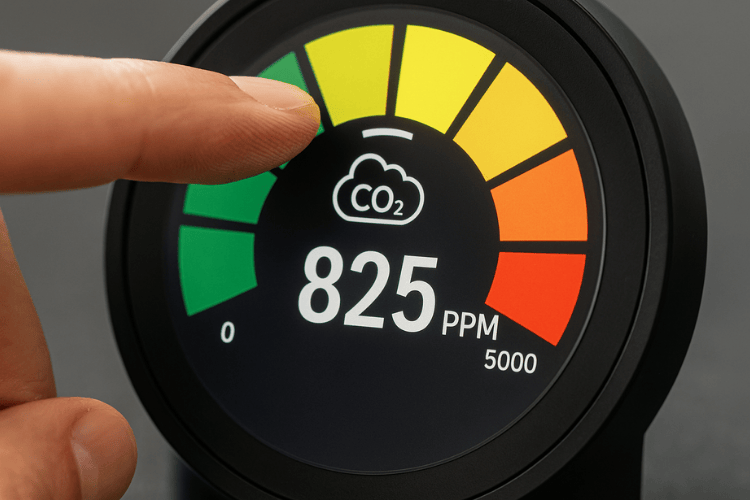
Air quality measurement using optical sensors
Optical sensors are often used in air quality monitors to detect certain gases or particles in the air. This is done either via infrared measurement or fluorescence measurement.
Among other things, the following readings can be determined using optical sensors: particulate matter (PM₁ – PM₂.₅ – PM₁₀), carbon dioxide (CO₂), oxygen (O₂), methane (CH₄), nitrous oxide, dinitrogen monoxide) (N₂O).
Air analysis via infrared measurement
Infrared measurement uses an infrared LED and a detector, separated by a wall inside the air quality monitor, so they never directly "see" each other. The infrared sensor (also known as an IR sensor) uses infrared light, which lies outside the visible light spectrum, to detect changes in its surroundings.
When a particle appears in the LED's light, the detector perceives a flash and responds to the rays emitted by the emitter (infrared LED). The detector measures the amount of reflected, or emitted, infrared light. This is based on infrared absorption. Some molecules absorb certain wavelengths of infrared radiation. The detector then determines how much light was absorbed at those specific wavelengths.
The sensor thus counts the frequency of the light flashes. For maximum accuracy, a second measurement beam (reflection sensor) can monitor the infrared LED's intensity, meaning its brightness. Here, the detector measures the reflected radiation. The brighter the flashes, the larger the respective particles. The dimmer the flashes appear, the smaller the particles. Changes in reflected intensity thus indicate the presence or properties of the air components.
Analyzing air pollutants through fluorescence
Some substances can fluoresce when irradiated with light of a certain wavelength, meaning they emit light of a different wavelength. By measuring fluorescence intensity, the optical sensor can infer the concentration of these substances. The measured fluorescence can be used for various applications, including detecting molecules, biomarkers, environmental pollutants, or other substances. The intensity, wavelength, and duration of the fluorescence provide information about the amount, concentration, or reaction kinetics of the analyzed substances.
Electrochemical sensors
Resistive sensors can be used to detect and quantify various gases. For this, the electrochemical sensor typically consists of three main components: a working electrode, a reference electrode, and a counter electrode. The working and reference electrodes are embedded in an electrolyte that supports ionic conductivity. When particles of the gas reach the sensor, an electrochemical reaction occurs there that's specific to the gas being detected. This reaction changes the ion concentration in the electrolyte in the immediate vicinity of the working and reference electrodes. Whenever corresponding particles "dock" on the sensor's surface, the substances cause a small current in the sensor — a measurable electrical signal.
The benefit of these sensor types is individual sensitivity calibration: various electrochemical sensors are thus specific to various gases, since the electrochemical reactions are gas-dependent. Specialized sensors are therefore used to detect carbon monoxide, sulfur dioxide, methane, and other gases. The drawback of electrochemical sensors is a possible cross-sensitivity to other gases. This means the respective sensors can also react to other gases and trigger a reading when they're present.
Among other things, the following readings can be determined using electrochemical sensors: sulfur dioxide (SO₂), volatile organic compounds (VOC), ammonia (NH₃), chlorine / chlorine gas (Cl₂), nitrogen dioxide (NO₂), carbon monoxide (CO), ozone (O₃), formaldehyde (CH₂O), hydrogen sulfide (H₂S), hydrogen (H₂).
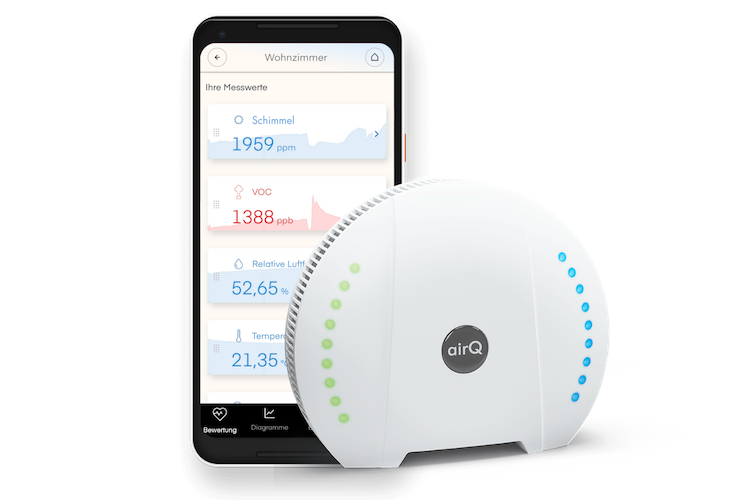
Mold & pollen: future air measurements with AI
So far, mold spores or pollen can't be directly detected using an air quality monitor, since they're barely distinguishable from other particles like dust. Currently, only the conditions that favor mold development can be determined, like excessive humidity and inadequate air exchange. We want to change that in the future using innovative technology. Together with TU Chemnitz, air-Q is therefore researching a way to measure mold and pollen. To do this, we're further developing our sensors and looking for AI-based solutions to distinguish particles by type and size. Artificial intelligence is meant to enable efficient processing and analysis of large amounts of data from various sensors and sources. Through the use of machine learning and data analysis algorithms, we aim to identify complex patterns and relationships in air quality data, hoping for more precise predictions, faster response times, and improved accuracy in detecting air pollutants.