
Air Quality in Classrooms – Why the CO₂ Traffic Light Matters So Much
Not just during pandemics is classroom air quality usually inadequate — the air is often stuffy. The recommended CO₂ concentration is quickly exceeded. Since ventilation isn't always adequate, infection risk also rises for students and teachers. CO₂ traffic lights provide relief and ensure better air quality.

Many people gather in a classroom: and breathe. An estimated eight liters of air per minute flow through each nose. This contains CO₂, carbon dioxide, which causes fatigue, headaches, and concentration problems. This naturally impairs students' ability to absorb information. After all, a good indoor climate with an adequate fresh air supply is essential for concentration and performance.
To retain learning material long-term and deliver full exam performance, students need the right conditions. The quality of the air breathed in the classroom is also of great importance here. Proper, adequate ventilation easily supports the needed concentration ability: an adequate fresh air supply minimizes the amount of carbon dioxide in the room and provides more oxygen. Regular ventilation also reduces air pollution from pathogens, such as aerosols. Moisture is also carried outside, lowering humidity, which reduces the risk of mold. It also removes odors and VOCs emitted by furnishings.
CO₂ traffic lights indicate excessive CO₂ concentration as a ventilation indicator
Even in small amounts, CO₂ leads to performance deficits. That's because the brain needs enough oxygen to work at full capacity. Usually, though, an elevated CO₂ load is only noticed once it's already too late. This can happen quickly, especially in fully occupied rooms. The German Federal Environment Agency therefore recommends that CO₂ concentration in classrooms not exceed 1,000 ppm, meaning CO₂ parts per million parts. Since that's fairly abstract, here's a tangible comparison: anyone enjoying fresh air outside is exposed to the minimal CO₂ concentration of 400 ppm.
The CO₂ traffic light as protection against illness
Ventilating not only boosts cognitive performance but also prevents colds caused by viruses, such as COVID-19 viruses. Aerosols are responsible for spreading the coronavirus: tiny particles that enter room air when exhaling and can spread while airborne over several meters. If there's a high concentration of aerosols in the classroom air, everyone's infection risk rises. With an air monitor, you determine room air's quality and pollutant exposure. If the share of exhaled CO₂ rises, it can be assumed that the share of aerosols in room air is also increasing. These measurements can therefore be used as a tool for Covid prevention.
Even though the number of aerosols and viruses in the air can't be measured directly, air's carbon dioxide content is a good indicator of when it's time to ventilate. This can lower infection risk in enclosed spaces. A good ventilation routine is therefore necessary in classrooms. The German Federal Environment Agency recommends: ventilate thoroughly three times an hour, i.e. every 20 minutes, with windows wide open. This is even more effective with a large temperature difference between indoors and outdoors. In cold outdoor temperatures in winter, a few minutes is enough, while on warmer days windows need to stay open longer to achieve the same effect.
Ideal air readings for schools & classrooms
CO₂ readings below 500 ppm are ideal. In full classrooms, though, values rise quickly. The German Federal Environment Agency therefore recommends ventilating from a value of 1,000 ppm. At 1,500 ppm — at the latest at 2,000 ppm — thorough ventilation is urgently needed. The table below illustrates the respective CO₂ concentration thresholds and their effect on air quality.
| CO₂ concentration | Air quality status |
| < 500 ppm | Very good |
| > 500 ppm | Acceptable |
| > 1,000 ppm | Limited |
| > 1,500 ppm | Critical |
| > 2,000 ppm | Poor |
If room CO₂ concentration exceeds ten times the recommended threshold, this can lead to nausea, shortness of breath, and even unconsciousness.
air-Q Lab: checking a classroom's ventilation concept
We wanted to know how quickly CO₂ concentration rises in a classroom. In our test, we used the air-Q in summer to track carbon dioxide content in room air in a fully occupied classroom with 27 people. The chart shows only the evaluation of the first two hours, since this already illustrates the effects of ventilation.
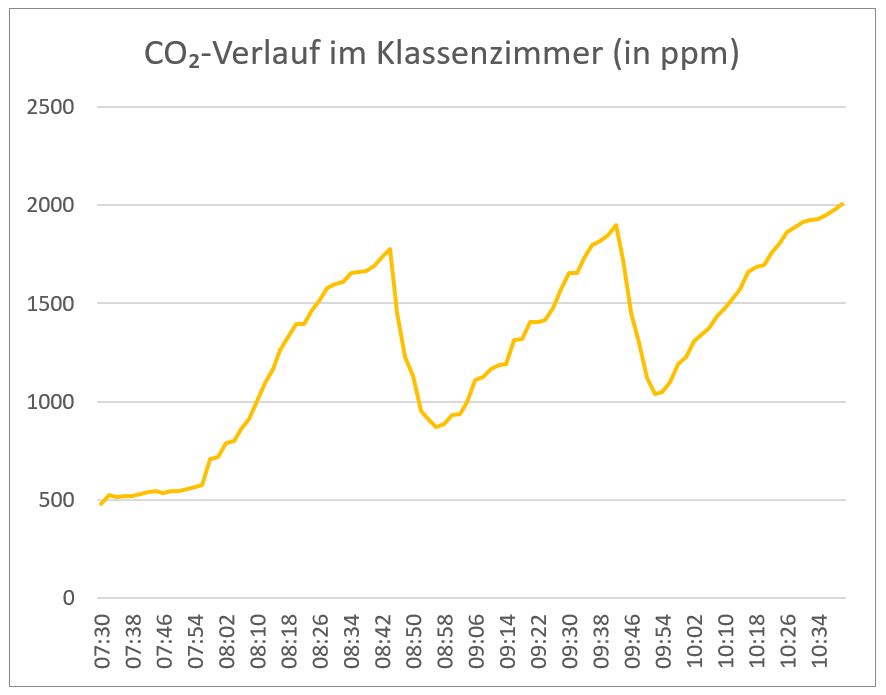
What does the chart show? The yellow line represents the CO₂ measured in the classroom. Right at 8 a.m., at the start of the first class, the CO₂ reading rose slowly but steadily. By a first short break at 8:45, the value climbed to 1,600 ppm. The room was then ventilated for the first time, dropping concentration to about 900 ppm. In the second class period, CO₂ content even exceeded the first period's values, growing to up to 1,900 ppm. This is mainly due to the fact that carbon dioxide concentration didn't drop sufficiently during the previous ventilation. The room was ventilated again at the long break, but even here concentration didn't drop enough, still sitting above 1,000 ppm.
The air-Q as a CO₂ traffic light
The air-Q test shows how important ventilation is at school. Although the classroom was ventilated repeatedly, ventilation duration was somewhat too short. Since the temperature difference between indoors and outdoors wasn't yet very large at the time of the test, a fast air exchange couldn't take place.
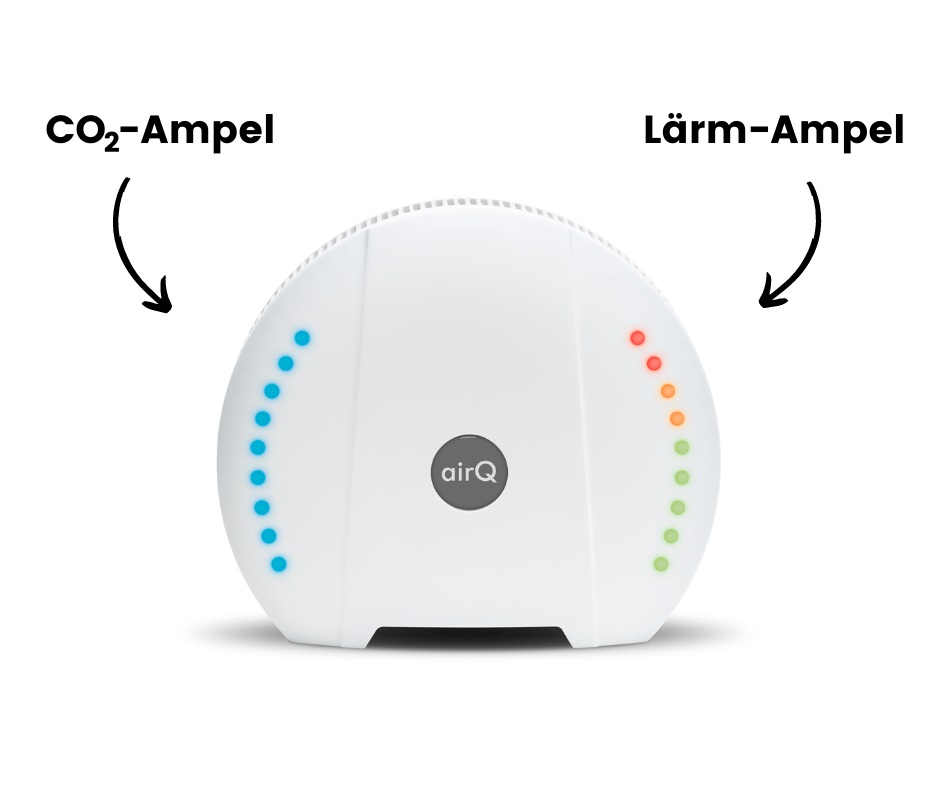
To optimally keep an eye on air quality and carbon dioxide content in classroom air, the air-Q air analyzer also functions as a CO₂ traffic light. LED displays in blue, orange, and red warn of too much CO₂ in the classroom, and thus also of a rise in aerosols. Through this colored light display, both teaching staff and students can easily read off when thresholds are reached, and thus a possibly elevated Covid infection risk, and take countermeasures.
Specifically for the needs of schools and offices, we developed the air-Q Light. It lets you very easily check how efficient ventilation is, and how the ventilation concept can be adjusted or expanded.
Noise measurement in the classroom
Classrooms don't just quickly get stuffy — they also get loud. High sound peaks and sustained noise, though, burden hearing. A high noise level disrupts teaching, impairs the ability to absorb information, and acts as a stress factor on the body. But it's not just performance and well-being that suffer. Noise also causes physical effects. If, for example, hair cells in the inner ear are permanently damaged by excessively loud sounds in the classroom, this impairs acoustic perception. These hair cells also can't regrow. Noise-induced damage is therefore irreparable and can lead to temporary or even chronic ear ringing (tinnitus) as well as hearing loss.
So you can keep an eye on volume as well as room air, the air-Q Light is equipped with a dedicated sensor. This lets it also be used as a noise meter, measuring decibels in the room. Here too, an easy-to-understand traffic-light system shows when the threshold is reached. If the class is quiet, this is shown by green LEDs. If restlessness increases, this is reflected by an orange glow — essentially a warning to the class. Red lights and an audible warning signal, on the other hand, indicate that noise level now needs to be drastically reduced. Even the youngest students understand this color scale.
This means the air-Q not only provides all-round preventive health protection but also boosts performance — for both students and teachers.
(Cover image: Shutterstock / Syda Productions)