
Put to the air-Q Test: The Dyson Pure Humidify + Cool Air Purifier & Humidifier
We tested the stylish humidifier, air purifier, and fan Dyson Pure Humidify + Cool. The device is large, heavy, and promises pure performance. We primarily examined the device's air purification function in relation to aerosols, using two air-Q Pro units with 14 sensors each. Among other things, we measured particulate matter, VOCs, and humidity.
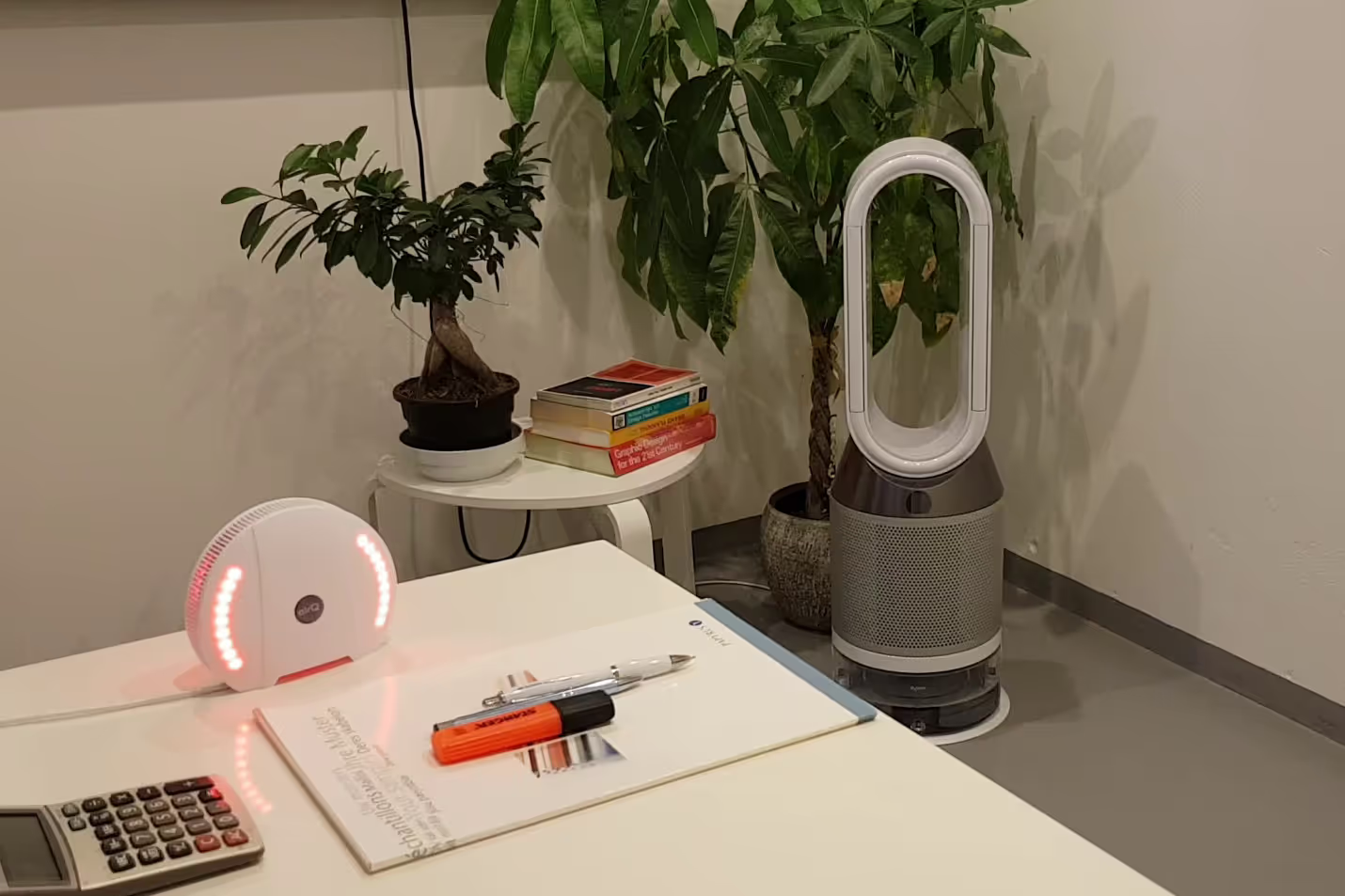
General experimental setup
The Dyson was set up in a normal office room measuring about ten square meters, with a ceiling height of three meters. The door remained closed at all times during the test, so no fresh air could enter from outside.
Test 1: How does the Dyson handle stale air?
The test was designed to show how effectively the Pure Humidify + Cool handles stale, polluted air and cleans it of aerosols and particles. For this, intensive work was carried out in the test office. First, 90 minutes of data were recorded with the two air-Q Pro units with the air purifier switched off. Starting at 12:15 p.m., the Dyson was then switched on for about 60 minutes, running at level 7 out of 10 during that time.
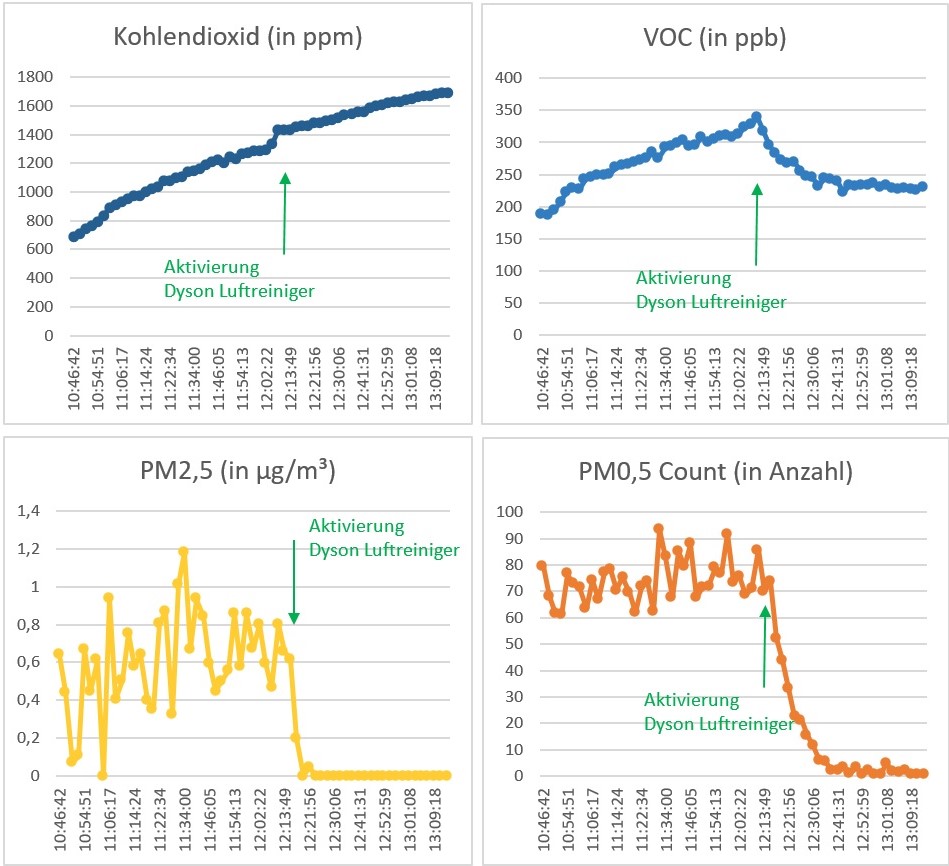
As expected, switching on the Dyson air purifier had no effect on the carbon dioxide content of the air (Figure 1). A minimal increase in CO₂ level is measurable via the air-Q air sensor on the desk. One possible explanation could be that the Dyson stirs up the heavier CO₂, which settles near the floor, mixing it with the rest of the air. In the first 90 minutes of the test, the VOC level rose to 350 ppb due to the test subject's breathing and sweating – a slightly elevated but normal value for indoor spaces.
After the Dyson Pure Humidify + Cool air purifier was switched on, the value fell noticeably and continuously until it settled slightly above the starting level (Figure 2), since VOCs were continuously being produced by the test subject present in the room.
During the test, particulate matter pollution was also measured. The value PM₂,₅ stands for particles smaller than 2.5 µm, measured in µg/m³. Particles of this size penetrate deep into the lungs, from where they can enter the bloodstream and cause cardiovascular disease. In addition, the PM₀,₅ particulate matter value was also recorded during the test. This stands for particles smaller than 0.5 µm and is measured here as a particle count per 100 ml of air, since the mass of these extremely small particles is negligibly low. These very fine particles are referred to as ultrafine particulate matter and are suspected of even penetrating as far as the brain, significantly increasing the risk of diseases such as Alzheimer's.
Before the air purifier was switched on in the room, particulate matter pollution was low and practically constant, at 0.4 to 0.8 µg/m³ for PM₂,₅. The air-Q measuring analyzer additionally counted up to 90 PM₀,₅ particles per 100 ml of air.
Once switched on, the Dyson Pure Humidify + Cool was able to reduce particulate matter pollution to practically zero. Even though the pollution level wasn't especially high, this still clearly shows that it also works reliably in the ultrafine particulate matter range – later in the test, the Dyson was subjected to a particulate matter stress test.
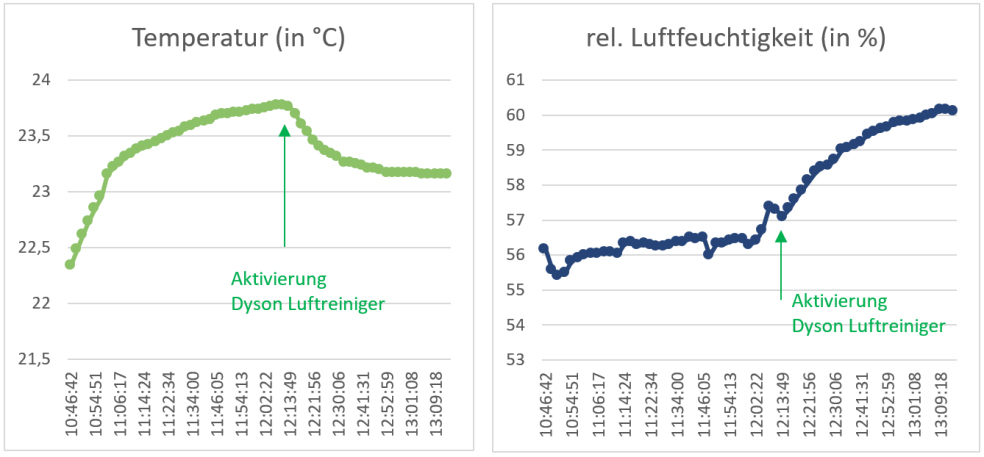
Throughout the entire test, the air-Q also recorded, among other things, temperature and humidity. After switching on the Dyson air purifier, the temperature curve flattened out noticeably downward. There are two explanations for this: it's possible that the temperature difference in the room was reduced by the air turbulence, lowering it at the height of the air-Q analyzer standing on the desk. Another possibility is that the temperature was reduced by the evaporative cooling of the water in the Dyson Pure Humidify + Cool. This would also explain the desired rise in humidity during the Dyson's operation. In any case, the temperature became noticeably lower and more pleasant once the Dyson was activated.
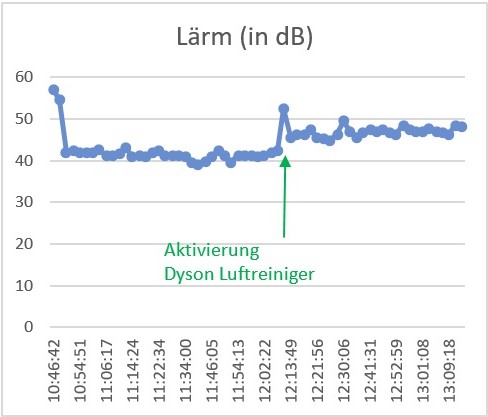
Regular office work (typing, clicking) carried out in the room during the test resulted in a noise level averaging just under 42 dB. After switching on the Dyson Pure Humidify + Cool, our measuring device recorded an increase in the measured volume to a still-quiet 48 dB. The distance between the air-Q and the air purifier was approximately two meters.
Here's our everyday test in fast-forward:
Test 2: How does the Dyson handle air heavily polluted with particulate matter?
To contaminate the air in a controlled way, an incense smoker figure was set up and lit. The air-Q triggered a fire alarm after just under ten minutes, since the particle pollution from the smoke in the small room was so high that the air analyzer assumed there was a fire. The incense smoker was extinguished, and we then waited 60 minutes so the contamination could distribute evenly throughout the room.
The air purifier was then activated, and the room was cleaned for around 60 minutes at level 7 out of 10.
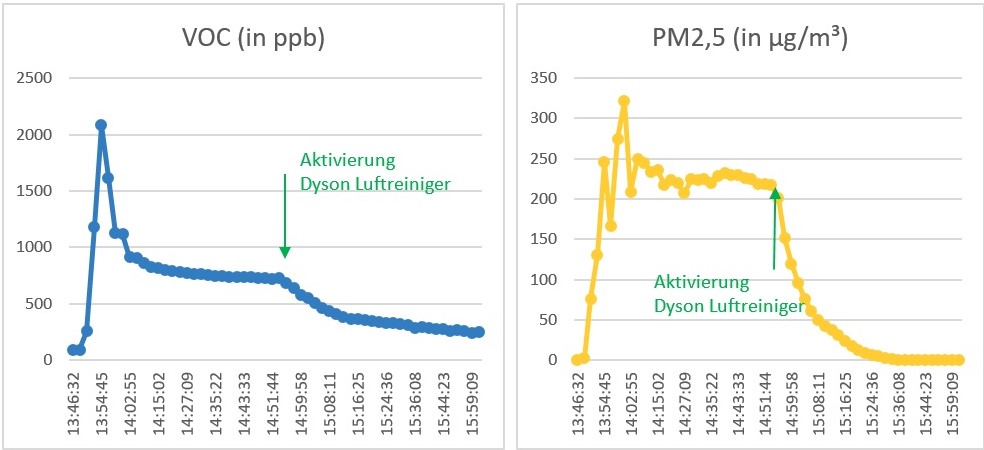
Immediately after switching on the Dyson Pure Humidify + Cool, the air-Q recorded a steep drop in particulate matter pollution, illustrated here using the PM₂,₅ values as an example. The level of flüchtige volatile organic compounds (VOC) also decreased. Within an hour, the extreme VOC contamination could be reduced to an almost neutral level of 270 ppb (parts per billion). The Dyson air purifier was excellent at neutralizing particulate matter – from a “fire-alarm level” of 220 µg/m³ down to “0” within 30 minutes. Something similar applies to the ultrafine particulate matter values (PM₀,₅), which – with a slight delay – could likewise be fully neutralized.
Here's our particulate matter extreme test in fast-forward:
Conclusion:
Purely based on its looks, the Dyson Pure Humidify + Cool air purifier & humidifier exudes power and technology. In the air-Q test, the Dyson lives up to that promise for the air purification functions tested. It's able to quickly neutralize even high levels of air contamination and can effectively counteract ongoing pollution during continuous operation (e.g. from open windows, people present, as well as chemicals present in furniture). The Dyson does a good job and reliably filters aerosols and particulate matter out of the air. On top of that, it can also humidify and cool the air.