
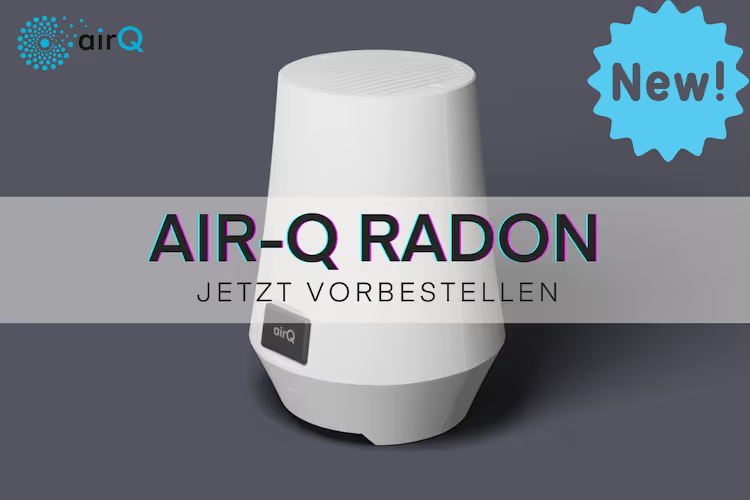
air-Q Radon: Your Smart Air Analyzer for Reliable Radon Measurements
Radon releases radioactive particles (so-called alpha radiation) as it decays. This is the leading cause of lung cancer in non-smokers! Our new air-Q Radon monitor tracks the dangerous noble gas in real time, checks for other pollutant sources in your indoor spaces, and gives you tips for optimal room air. Here it is.
What is radon?
Radon (Rn) is a radioactive chemical element and, with a mass of 9.73 mg/cm³, one of the heaviest gases. It's colorless, odorless, and tasteless, and occurs as various atomic types (isotopes), all of which are radioactive. The most stable naturally occurring isotope, 222Rn, has a half-life of 3.8 days.
Radon enters buildings from the ground or the building site. How high the concentration is in a room depends on:
- how much radon is present in the soil & released
- how permeable the ground is
- how the building is constructed
- how often the rooms are ventilated
What health risks does an excessive Rn concentration pose?
In poorly ventilated enclosed spaces, the radioactive gas can accumulate and lead to elevated radon exposure, posing a health hazard. Smokers are especially at risk, since the carcinogenic properties of radon and tobacco smoke reinforce each other. But radon is also a leading cause of lung cancer among non-smokers. According to the World Health Organization (WHO), radiation levels between 100 and 200 Bq/m³ already significantly increase lung cancer risk. Studies show the risk rises by 10% per 100 Bq/m³. Germany's Federal Office for Radiation Protection recommends taking preventive reduction measures from a radon concentration of 100 Bq/m³ onward.
How radon affects health:
- cell damage to the lungs
- genetic mutations
- lung cancer
Detecting radon with the air-Q
If you want to protect yourself from the health effects of radon, you need to determine the concentration of this colorless, odorless gas in your rooms. With the air-Q, you can measure radon reliably and quickly, in seconds or via long-term measurements. Besides the radon reading, the new air-Q Radon captures 7 other readings via dedicated sensors: CO₂, air temperature, relative and absolute humidity, dew point, air pressure, and volatile organic compounds (VOCs). Each reading has its own dedicated, high-quality sensor built into the device, so the air-Q can precisely distinguish between the different measurement types.
So you can use the air-Q Radon both as a measuring instrument for the radioactive gas and as an air analyzer for other important readings.
The air-Q Radon also offers unbeatable value for money: it's one of our more affordable devices, with a comparable sensor set to our air-Q light. Via the air-Q smartphone app, you can view all readings as charts and track how they develop over time, letting you adjust your ventilation habits accordingly.
The air-Q Radon is currently in the final stages of development. Starting this summer, you'll be able to get our new radon monitor: pre-order now for a discount and a surprise.
Your air-Q Radon benefits at a glance:
- radon sensor developed & manufactured in Germany
- very high accuracy
- many further sensors already included in the device
- short 10-second measurement intervals
- simultaneous display of two readings via LED bars
- cloud storage
- USB port
- offline use
- smart app with significantly more features than comparable devices
- built-in health advisor and AI algorithms that can analyze correlations
- alarm function & push notifications
- smart home connectivity (Apple HomeKit via Homebridge, IFTTT, Home Assistant, FHEM, Homey, openHAB, ioBroker, Node-RED)
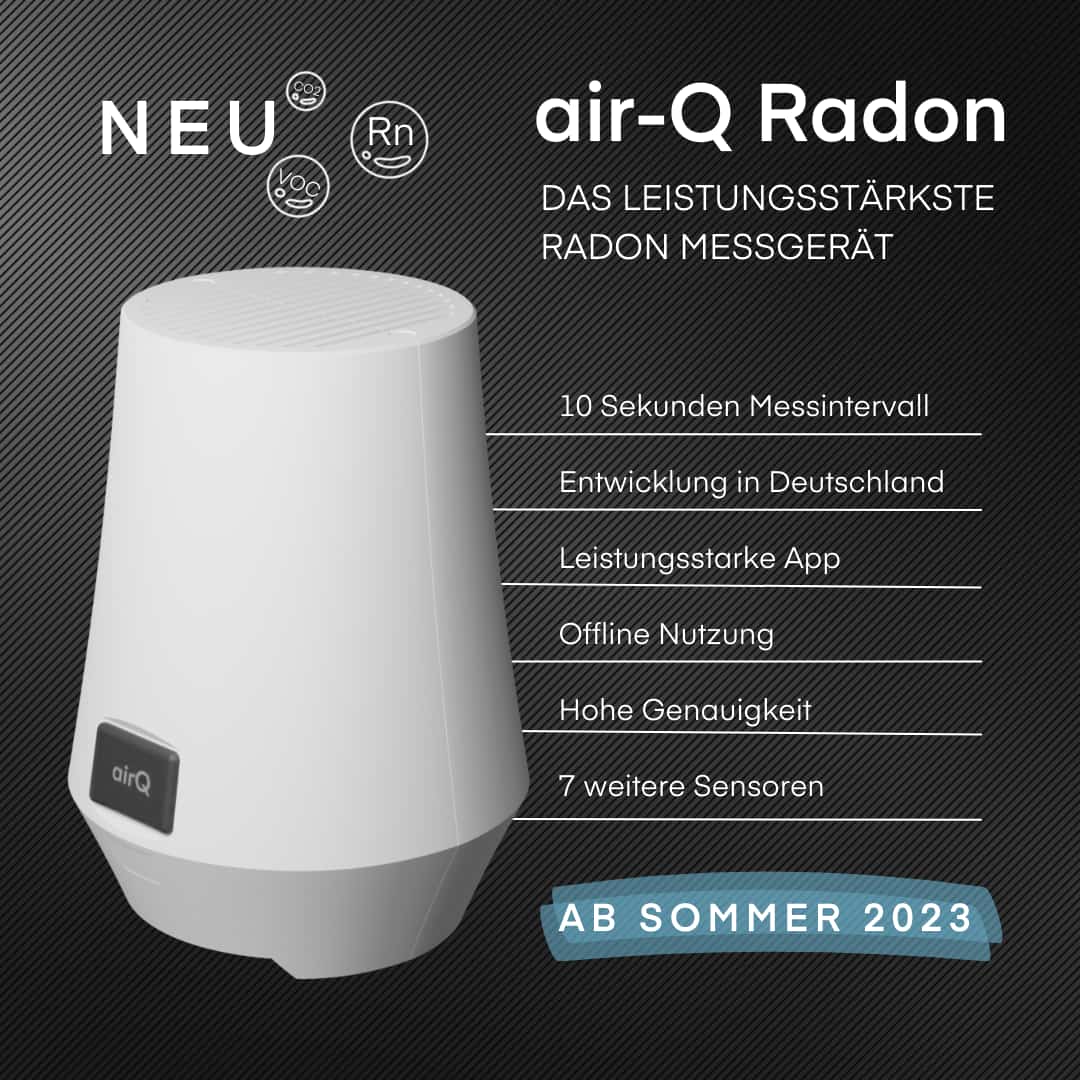
You'll be able to borrow the air-Q Radon for a short-term air analysis in your spaces and determine radon exposure. Achieve a much healthier indoor climate by uncovering potential pollutant sources in real time. Our devices alert you to possible hazards and threshold exceedances via an LED traffic light system on the device as well as push notifications. Start your air analysis this summer 2023 and find out whether radon and other air pollutants are present in your indoor air.