
air-Q Lab: When Do You Really Need to Ventilate?
For a good indoor climate, stale air needs to go out and fresh air needs to come in. But when do you actually need to ventilate? The usual recommendations are often unrealistic: 5 to 10 minutes every two hours. When you should actually open the windows depends on several factors. In our air-Q Lab, we test which readings really matter.

General statements about fixed ventilation times are difficult in most cases. That's because these figures account for neither actual moisture loads nor local conditions nor the number of people in the room. Yet these factors are important and largely determine when you should ventilate. After all, the share of, say, carbon dioxide rises faster when more people are in a room, since more CO₂ is exhaled. The air quickly becomes "stale." Discomfort, fatigue, or even headaches are the result.
Besides normal metabolic processes, indoor spaces also release pollutants that off-gas from things like carpets or furniture – so-called volatile organic compounds (VOCs). These air pollutants should also be regularly cleared out.
The occupancy factor: When do you need to ventilate?
In our first test, we checked air quality with our air-Q air monitor in a 25 m² room. We ran the experiment with 1, 2, 3, and 4 people. We observed when the air-Q detected a threshold exceedance and recommended ventilating.
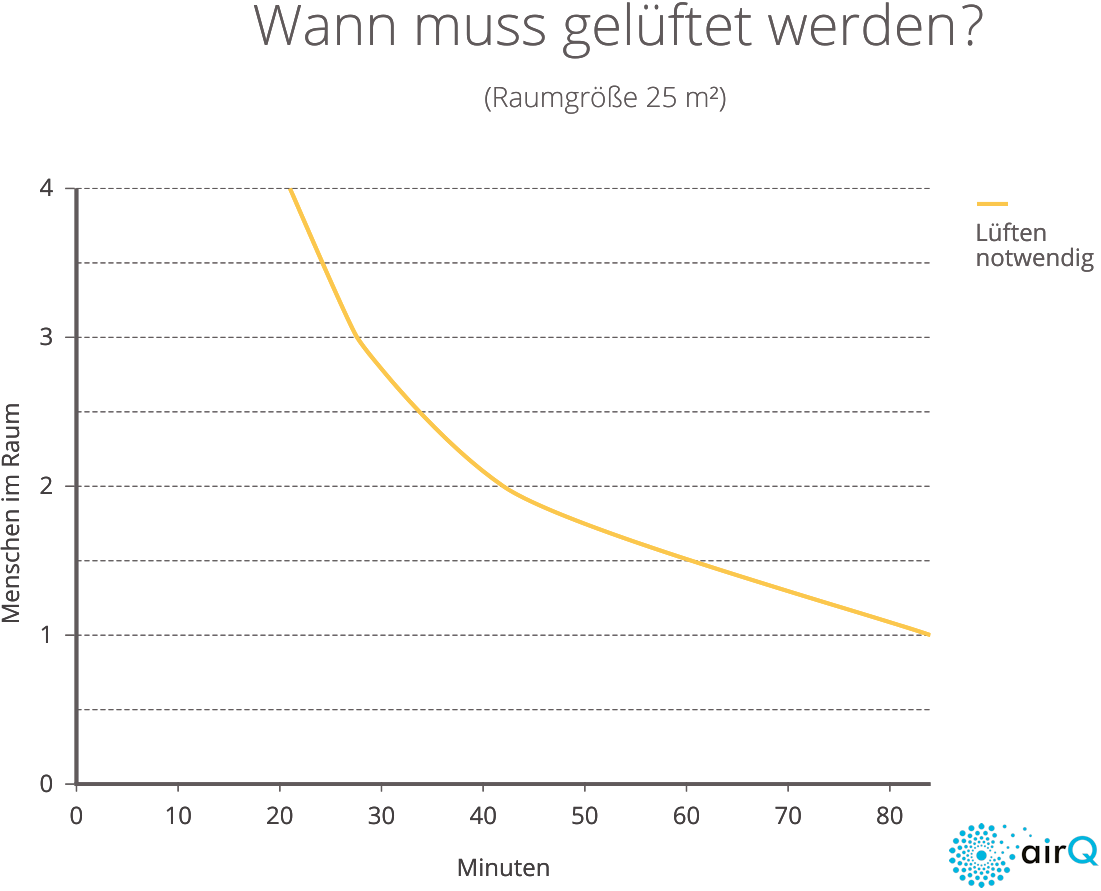
The curve of our analysis clearly shows: the more people in the room, the shorter the interval until ventilation is recommended. While the air-Q recommends ventilating only after 80 minutes with just one person in the room, the warning appears after barely 40 minutes with two people, after half an hour with three people, and after about 25 minutes with four people.
The difference in air consumption between three and four people in the room is fairly small. In both scenarios, the air-Q air monitor triggers after roughly 25 to 30 minutes. Between one and two people, however, a much bigger difference is noticeable: here the time figures halve, from 80 minutes with one person to 40 minutes with two people in the room.
What matters here is that ventilation needs to be repeated. With three or four people in the room, you should therefore ventilate every 20 to 30 minutes. With two people, it's enough to exchange the air every 40 minutes, and with one person, fresh air every 80 minutes is advisable.
The room-size factor: When do you need to ventilate?
In our second experiment, we varied room size instead of occupancy. Across several test runs, we examined air quality in rooms of the following sizes: approx. 10, 20, 30, 40, and 50 m². Two people were always present in the rooms. Here too, the air-Q air monitor showed us when to ventilate.
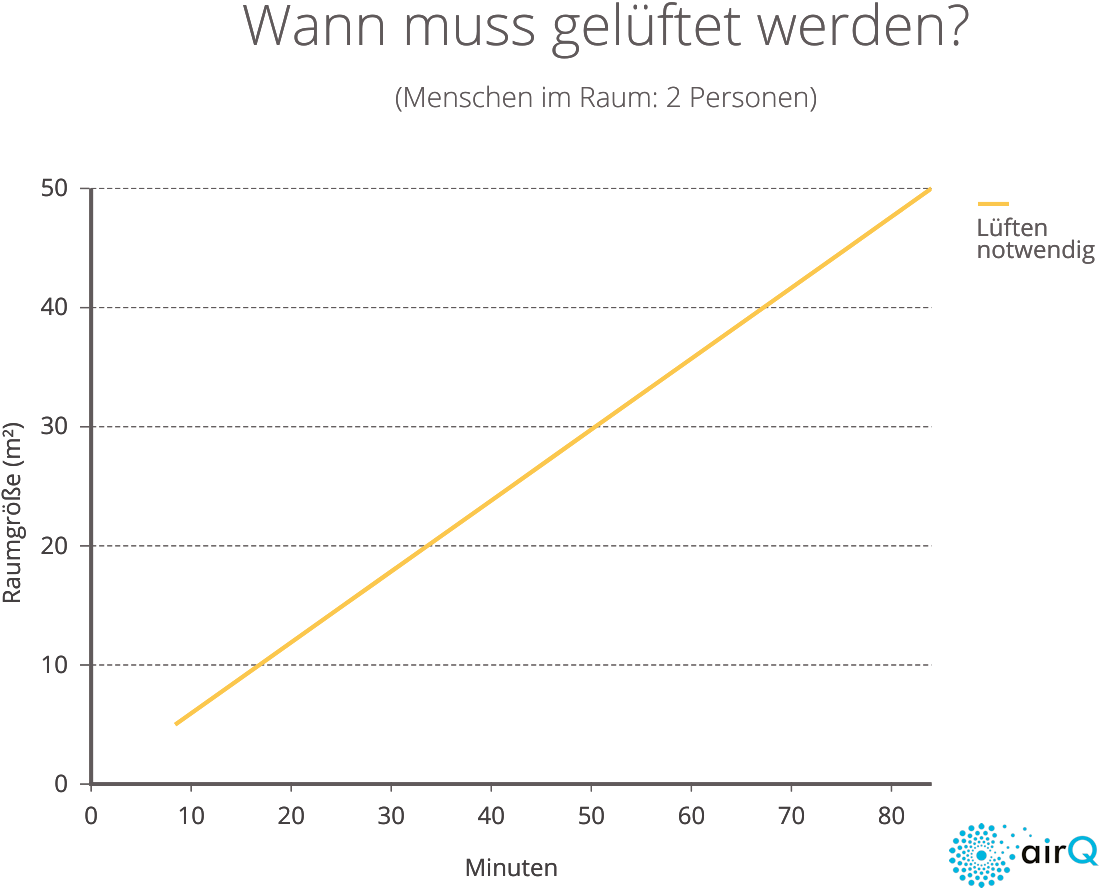
The readings make clear that in small rooms, the air becomes stale and needs ventilating much sooner. In a room of about 10 m², the air-Q already flags an exceedance of the recommended threshold after just ten minutes. In a 20 m² room, the air-Q recommends ventilating after about 30 minutes. At 30 m², it's enough to open the windows every 50 minutes, and at 40 m² every 65 minutes. In a 50 m² room, air quality holds up longest. Here, ventilating every 80 minutes is enough.
Conclusion
Our tests show that ventilation frequency depends heavily on the factors of occupancy and room size. We were surprised by how quickly the thresholds were exceeded. You should therefore ventilate far more often than you'd think, especially in small rooms. This of course applies not only to your private spaces, but also to small offices, meeting rooms, or classrooms. These rooms typically measure around 30 m² and should be ventilated correspondingly often.