
air-Q Lab: How Effective Is the Briiv Air Purifier Against Particulate Matter From Cooking?
Cooking produces invisible particulate matter that can significantly impair kitchen air quality. The natural air purifier Briiv promises to effectively reduce this pollution. We measured whether it works in a real-world experiment with our air-Q air monitor.
Particulate matter from cooking: how cooking & frying affect health
Let's start with a small thought experiment: you're preparing dinner in your kitchen. The oil sizzles in the pan, the aroma of fresh vegetables and a fried egg fills the room. What you can't see, however, are the tiny particulate matter particles released into the air with every cooking process. These particles, released among other things by heating food and oils, can penetrate deep into the respiratory tract and trigger inflammation there.
Long-term exposure to particulate matter can lead to respiratory diseases, cardiovascular problems, and a worsening of existing health conditions. Especially in enclosed spaces, where particles can't simply escape, it's important to keep an eye on air quality and take steps to reduce pollution.
We wanted to know how much particulate matter is released while frying. We were also curious whether the natural air purifier Briiv could influence the measurement results. So we used our air monitor air-Q to examine how the reading developed across two different experiments: once with the Briiv and once without the air purifier.
Moss air purifiers: natural freshness for your home
Moss air purifiers are an innovative, eco-friendly way to improve indoor air quality. These unique air purifiers use the natural properties of moss to filter pollutants from the air while also providing pleasant room humidity. But how does a moss air purifier work, and why is it a good choice for your home?
Moss is known for its ability to absorb moisture from the air while binding pollutants such as particulate matter and volatile organic compounds (VOCs). A moss air purifier harnesses these natural abilities to effectively clean the air in your home. The moss acts not only as a filter but also as a natural humidifier, improving the indoor climate and creating a pleasant living feel.
Another benefit of moss air purifiers is their low maintenance requirement. Unlike conventional air purifiers, they need no power supply or regular filter changes. The moss regenerates itself and only needs occasional spraying with water to maintain its air-purifying abilities.
Moss air purifiers are not only functional but also visually appealing. They blend harmoniously into any living space and bring a piece of nature into your home. Whether in the living room, bedroom, or office – a moss air purifier is a stylish and sustainable way to improve air quality.
If you're looking for a natural, low-maintenance air purification solution, a moss air filter for the home is an excellent choice. It combines the benefits of natural air purification with an appealing design and helps create a healthy, pleasant indoor climate.
Briiv – the natural air purifier
The Briiv is an air purifier that relies on natural materials such as moss, coconut fibers, and wool to improve indoor air quality. Using AI-powered sensors, Briiv detects and filters particulate matter, pollutants, and odors from the air. According to the manufacturer, the air purifier is meant to noticeably clean the air in small to medium-sized rooms. In our two-stage experiment, we compared particulate matter pollution from cooking with and without using the Briiv.
air-Q Lab particulate matter development while cooking: two days, two scenarios
We ran the air-Q experiment to test how effective the natural air purifier Briiv is at reducing particulate matter in room air. On two consecutive days, the same dish – a fried egg with four slices of zucchini – was prepared. On the first day, the Briiv air purifier was active, and on the second day it was not.
This air-Q Lab test is not a scientific experiment but rather a real-world test. Neither the test environment nor local conditions were controlled — they were subject to natural fluctuation. This self-test therefore reflects real conditions in a kitchen, but doesn't meet scientific standards.
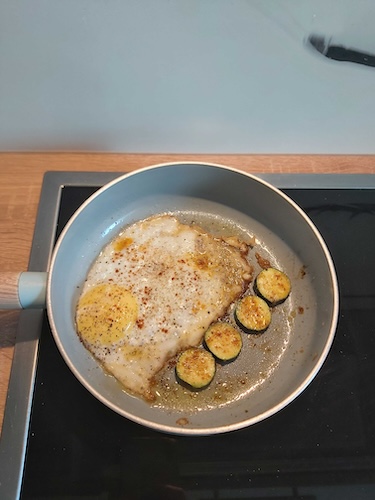
air-Q Lab day 1: cooking with the Briiv air purifier
On the first day, the experiment started at 5:18 p.m. Beforehand, the kitchen was ventilated so that starting values were below 15 μg/m³ (micrograms per cubic meter).
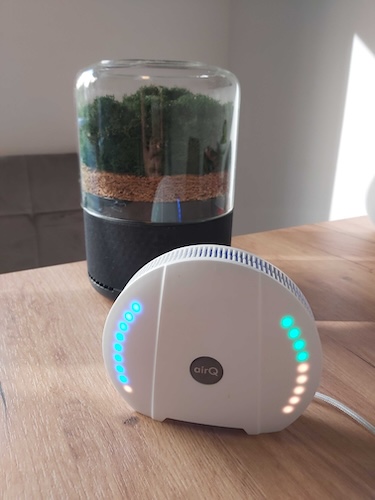
Air quality was monitored throughout the experiment with the air-Q air monitor, and the Briiv was active on its highest setting during the cooking process. Shortly after frying began, particulate matter pollution rose exponentially within a short period of three minutes. After the first peak of just under 100 μg/m³ was reached, the curve grew linearly for another ten minutes. Around 5:37 p.m., the air-Q recorded the following peak values for particulate matter readings PM₁, PM₂.₅, and PM₁₀ :
- PM₁: 133 µg/m³
- PM₂.₅: 122 µg/m³
- PM₁₀: 86 µg/m³
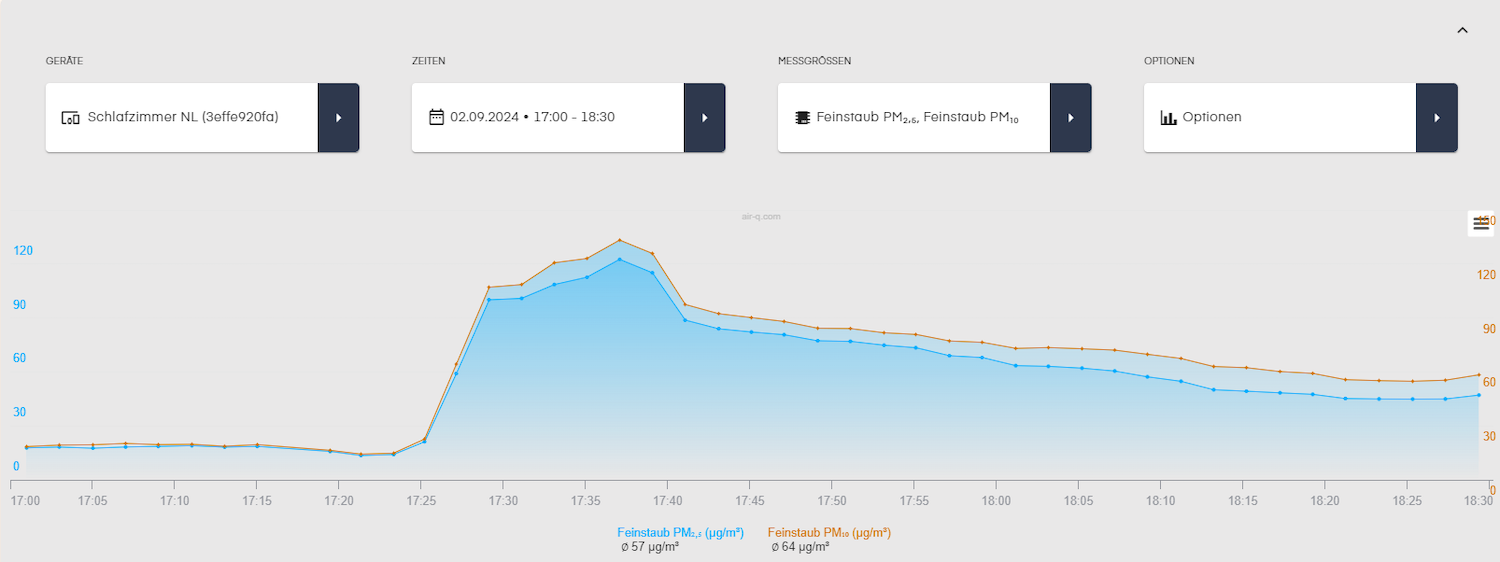
After frying ended at 5:28 p.m., particulate matter pollution steadily declined again. Another hour later, a measurement at 6:28 p.m. showed the readings had dropped significantly. All particulate matter particle sizes showed a clear decline of about 60%. The exact values break down as follows:
- PM₁: 54.1 µg/m³, a decrease of 59.32%
- PM₂.₅: 44.2 µg/m³ (decrease of 63.77%)
- PM₁₀: 31.1 µg/m³ (decrease of 63.72%)
air-Q Lab day 2: cooking without the Briiv air purifier
On the second day, cooking began at 6:54 p.m., but without using the Briiv. Air readings were again continuously measured with the air monitor for the home air-Q. The initial particulate matter reading was about 12 μg/m³. Compared to the previous day's experiment, the reading rose noticeably slower – until the highest particulate matter reading was measured at 7:21 p.m. Particulate matter pollution broke down across particle sizes as follows:
- PM₁: 67.8 µg/m³
- PM₂.₅: 93.6 µg/m³
- PM₁₀: 100.5 µg/m³
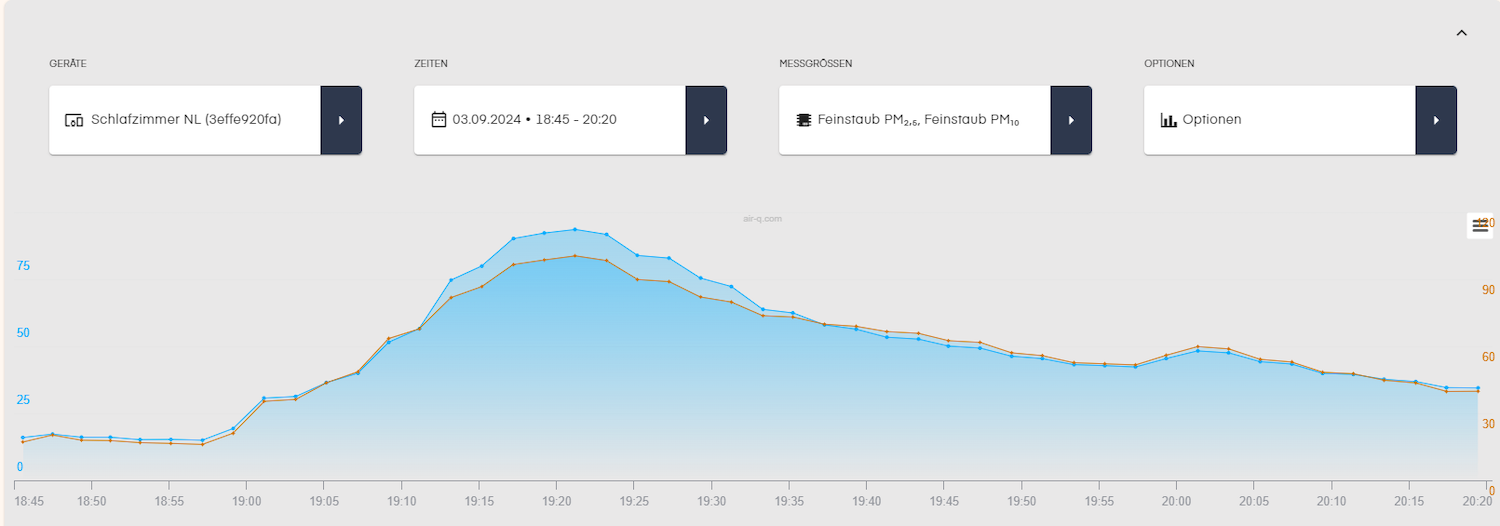
In direct comparison with the first test, the peak values were substantially lower. After frying, particulate matter pollution declined again. Here too, a continuous curve is visible, though after about 30 minutes there was another small increase of about 20 μg/m³. Looking at how readings developed after one hour (at 8:05 p.m.), the following values resulted:
- PM₁: 34 µg/m³ (decrease of 49.85%)
- PM₂.₅: 48.3 µg/m³ (decrease of 48.40%)
- PM₁₀: 59.9 µg/m³ (decrease of 40.38%)
Conclusion: cooking with & without the Briiv air purifier – comparing results & interpretation
Comparing the two days clearly shows that the Briiv air purifier plays an effective role in reducing particulate matter. With the Briiv, particulate matter readings dropped faster and more steeply than without it. Note that the starting values on the second day weren't as high as on the first, which affects the calculations.
Possible reasons for lower particulate matter readings on the second day:
- Ventilation conditions: the room may have had better ventilation on the second day.
- Environmental factors: temperature, humidity, or air currents may have differed. (Fresh laundry drying raises room humidity — particulate matter particles bind to it)
- Cooking behavior: slight differences in the cooking process, such as cooking temperature, could also have played a role.
It's important to note that with lower starting values, particulate matter can dissipate faster. This means the percentage differences might have been even larger if the starting values had been more directly comparable. Even so, the experiment clearly shows that using the Briiv significantly improved air quality after cooking.
Want to monitor air quality while cooking too? Then get to know our air-Q air monitor and its different models better now.