
air-Q Lab: The Blueair Classic 680i Air Purifier Put to the Test
The Blueair Classic 680i air purifier promises clean indoor air – but how well does it really filter pollutants? Its effectiveness was tested in our experiment with an incense cone and deodorant. Find the results here.
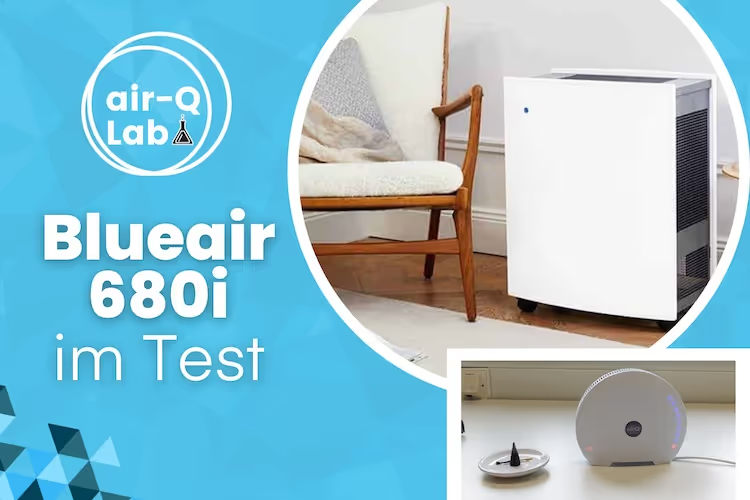
First impression of the Blueair Classic 680i air purifier
The air purifier made a solid, high-quality impression, though lifting it was difficult due to its weight. Thanks to the built-in casters, though, it's easy to move around the room once you've lifted it out of the box. The build feels sturdy and has a simple design. Despite its size, the unit runs fairly quietly – even on level 3. Operation is intuitive via just a few buttons, which makes handling easier.
According to the manufacturer, the Blueair Classic 680i filters room air at a rate of five air changes per hour (roughly every 12 minutes). The unit is suited to rooms up to 72 square meters. This lets the air purifier effectively lower particle concentration in the air and guarantee a pleasant, healthy environment even in especially large open-plan homes, studios, or basements. To do this, the Blueair Classic 680i combines electrostatic and mechanical filtration in its HEPASilent technology. This produces low-density filters that require less air pressure than conventional HEPA filters. That means quieter, more energy-efficient air purification without any loss of performance.
More information about the air purifier can be found here.
air-Q Lab Blueair Classic 680i air purifier: test setup & procedure
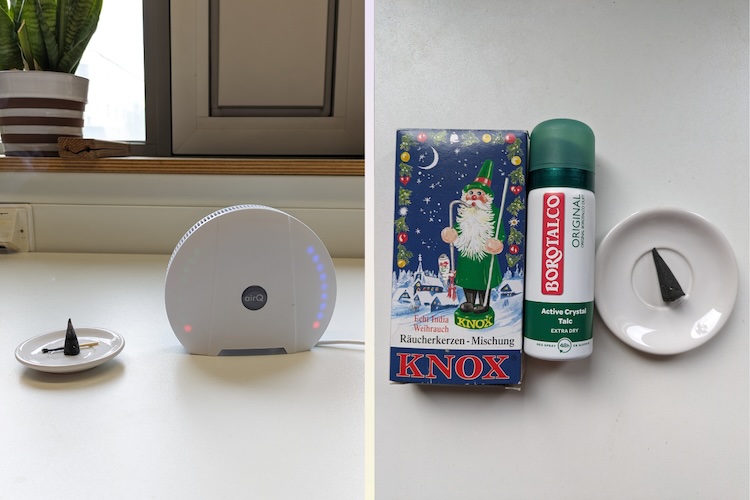
In our experiment, we wanted to check how effective the Blueair Classic 680i air purifier with particle filter really is. Our test focused on reducing particulate matter (PM₁₀ and PM₂.₅) and volatile organic compounds (VOCs) in a 24 m² room. To simulate heavy pollution, an incense cone was lit and a deodorant spray was also used. Throughout the experiment, air quality was measured and logged with the air-Q air monitor. For a meaningful conclusion about how the air purifier performs, we ran the experiment twice: once without and once with the Blueair Classic 680i.
Test 1: Particulate matter development with & without the air purifier
Before starting the experiment, the room was thoroughly ventilated to establish a clean baseline. At 9:01 a.m., room pollution was simulated by lighting an incense cone and spraying deodorant.
Measurement results: particulate matter development without the air filter
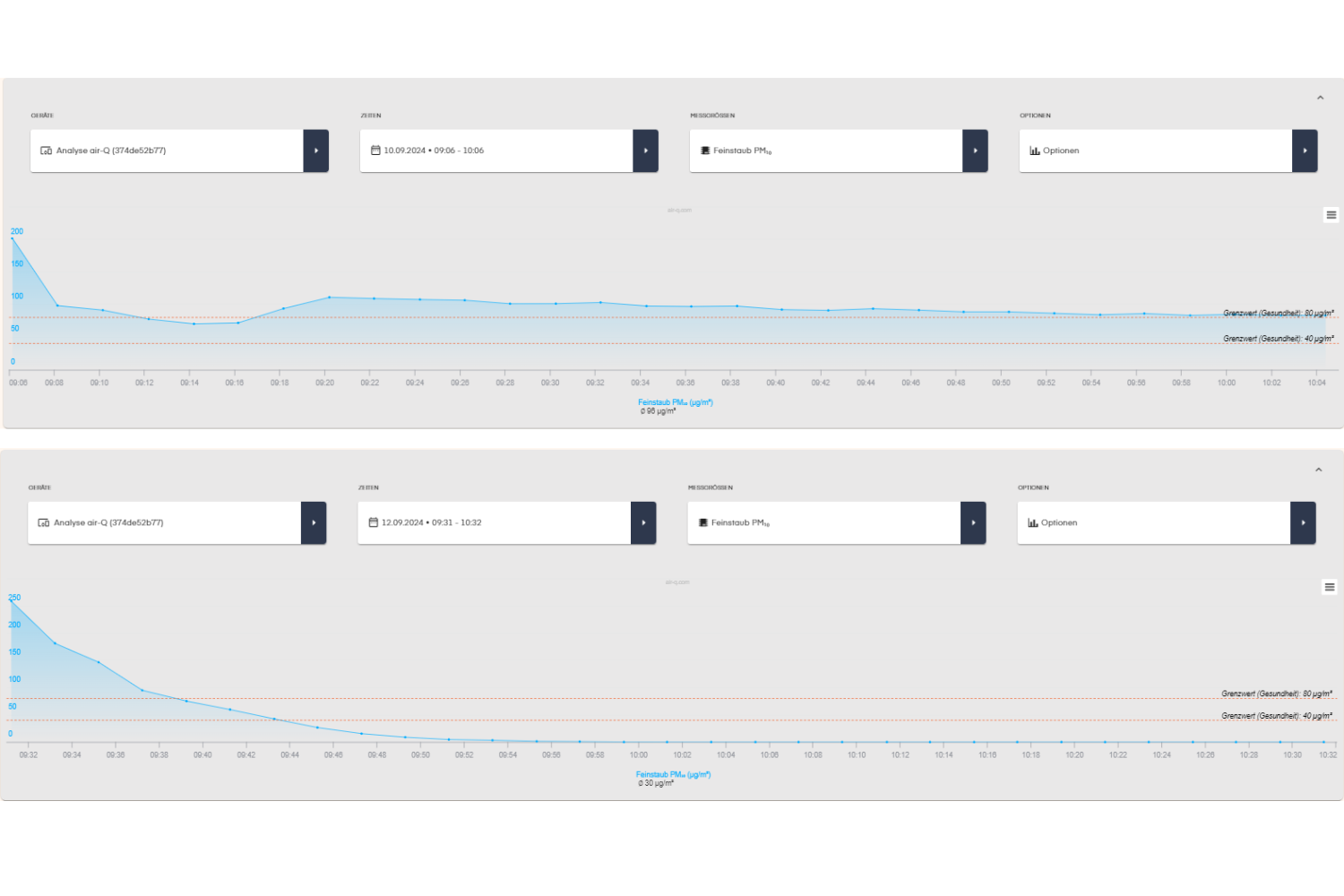
The particulate matter reading rose to just over 200 μg/m³, exceeding the recommended daily threshold of 50 μg/m³ many times over. After five minutes, the incense cone was extinguished and pollutant levels initially declined continuously. After just 2 minutes, the particulate matter reading had already halved. The curve then declined much more slowly and briefly even dipped below the threshold. Following this brief recovery in particulate matter levels, the air-Q air monitor detected a renewed rise. The threshold was exceeded again and leveled off at just under 100 μg/m³.
Only 6 hours after the experiment did readings drop below the recommended limit of 40 μg/m³. Particulate matter pollution from incense cones and the like therefore lingers in a room for a very long time without an air exchange, such as air purification. The particles are readily absorbed through breathing and, due to their minimal size, penetrate deep into the body.
Development of PM₁₀ particulate matter readings at a glance:
- Starting value (9:06 a.m.): 201 µg/m³
- Reading after 1 hour (10:06 a.m.): 83.4 µg/m³
- Dropping below the threshold (40 µg/m³): A value of 39.5 µg/m³ wasn't reached until 3:07 p.m.
Measurement results: particulate matter development with the air filter
For the second test run with the air purifier as well, the room was ventilated beforehand. At 9:30 a.m., air pollution was simulated by lighting the incense cone and spraying deodorant. At 9:35 a.m., the incense cone was extinguished and, at the same time, the Blueair Classic 680i air purifier was switched on at level 3. Regarding the PM₁₀ particulate matter reading, a starting value of 258 µg/m³ was recorded at 9:30 a.m. The air monitor documented a steady decline in the pollutant. Already by 9:39 a.m., the threshold of 60 µg/m³ was reached, corresponding to a reduction of about 76.7%. The stricter threshold of 40 µg/m³ was already undercut by 9:44 a.m. with a value of 38.5 µg/m³. The particulate matter reading continued its steady decline until, at 9:54 a.m., the value dropped to 0 µg/m³ – meaning the particulate matter had been completely eliminated after just 24 minutes. Even an hour later, at 10:31 a.m., the reading remained at 0.0 µg/m³.
Development of PM₁₀ particulate matter readings at a glance:
- Starting value (9:35 a.m.): 258 µg/m³
- Reading after 1 hour (10:31 a.m.): 0.0 µg/m³
- Dropping below the threshold (40 µg/m³): The threshold was already undercut after just 15 minutes, at 38.5 µg/m³.
The air-Q's evaluation charts clearly show the difference during the experiment: top, without the air purifier; bottom, with the Blueair Classic 680i air purifier:
Test 2: VOC reading development with & without the air purifier
Besides particulate matter readings, we also looked at how volatile organic compounds developed. These readings are significantly affected by the use of scented candles and the like.
Measurement results: VOC development without the air filter
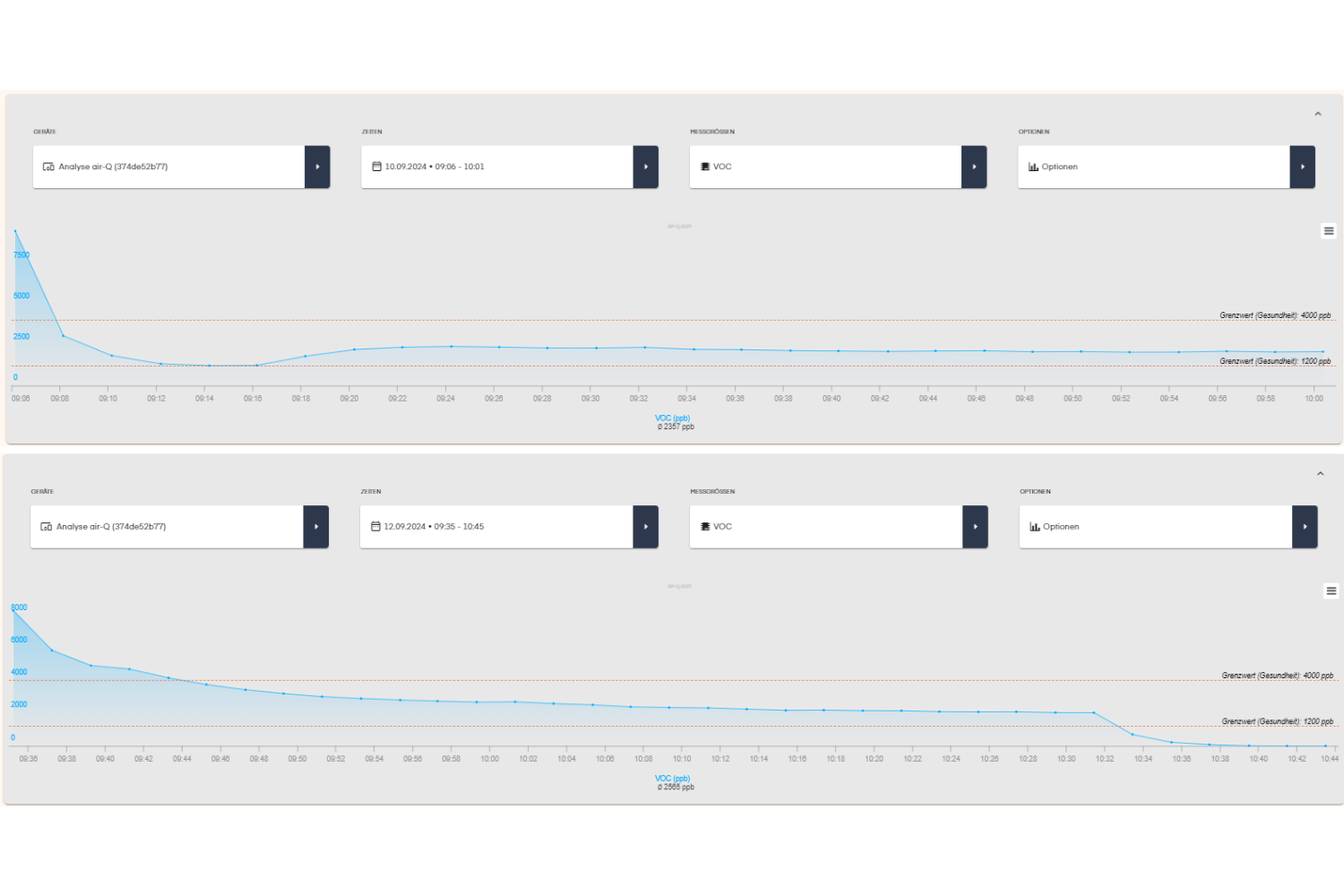
At the start of the experiment at 9:05 a.m., the concentration of volatile organic compounds (VOCs) was 9085 ppb, exceeding the threshold of 4000 ppb by 127.1%. Already after 2 minutes, a rapid decrease in VOC pollution was observed, as the value fell to 2500 ppb. After 10 minutes, the concentration reached about 1200 ppb. However, pollution then increased significantly again. Over a period of 4 minutes, readings rose again and eventually stabilized just above 2000 ppb. One hour after the start of the experiment, at 10:05 a.m., a concentration of 2076 ppb was measured. The threshold of 1200 ppb was therefore never undercut during the entire measurement period; even at 6:00 p.m., the value remained above 2000 ppb.
Development of VOC (volatile organic compounds) at a glance:
- Starting value (9:05 a.m.): 9085 ppb
- Reading after 1 hour (10:05 a.m.): 2076 ppb
- Dropping below the threshold (1200 ppb): The threshold was not undercut during the entire measurement period.
%2520(300%2520x%2520250%2520px)%2520(1).jpeg)
Measurement results: VOC development with the air filter
The concentration of volatile organic compounds (VOCs) started at 9:35 a.m. with a starting value of 8276 ppb, exceeding the threshold of 4000 ppb by more than double (106.9%). Shortly after the experiment began, pollutants started to decline steadily. By 9:44 a.m., the threshold of 4000 ppb was undercut, corresponding to a decrease of about 51.6%. The VOC value continued to decline steadily – until a value of 2000 ppb was reached at 10:00 a.m.
At 10:32 a.m., there was a rapid drop from about 1700 ppb to about 600 ppb within one minute, so the second threshold of 1200 ppb was already undercut at 10:33 a.m. with 706 ppb. One hour after the start of the experiment, at 10:35 a.m., the VOC concentration was thus only 221 ppb, clearly below the recommended threshold of 1200 ppb. At 10:38 a.m., about 63 minutes after the start of the experiment, the air-Q device no longer showed any pollutant particles in the air. The VOC concentration reached the zero point, where it remained until the end of the experiment.
Development of VOC (volatile organic compounds) at a glance:
- Starting value (9:35 a.m.): 8276 ppb
- Reading after 1 hour (10:35 a.m.): 221 ppb
- Dropping below the threshold (1200 ppb): The threshold was already undercut at 10:33 a.m. with 706 ppb.
For this reading too, the air-Q's evaluation charts show a noticeable difference between pollutant development with and without air purification. The first chart shows the air analysis for the test without an air purifier, the lower one the VOC pollution while using the Blueair Classic 680i air purifier:
Impact on the health index from pollutant development
With the air-Q air monitor, besides analyzing the air composition, you also get a health index reading. To do this, the air analyzer continuously analyzes all relevant substances in the air you breathe and compares them against thresholds from the WHO, the German Federal Environment Agency, and scientific studies. The result is used to calculate the air-Q health index. For our experiments, this produced the following charts:
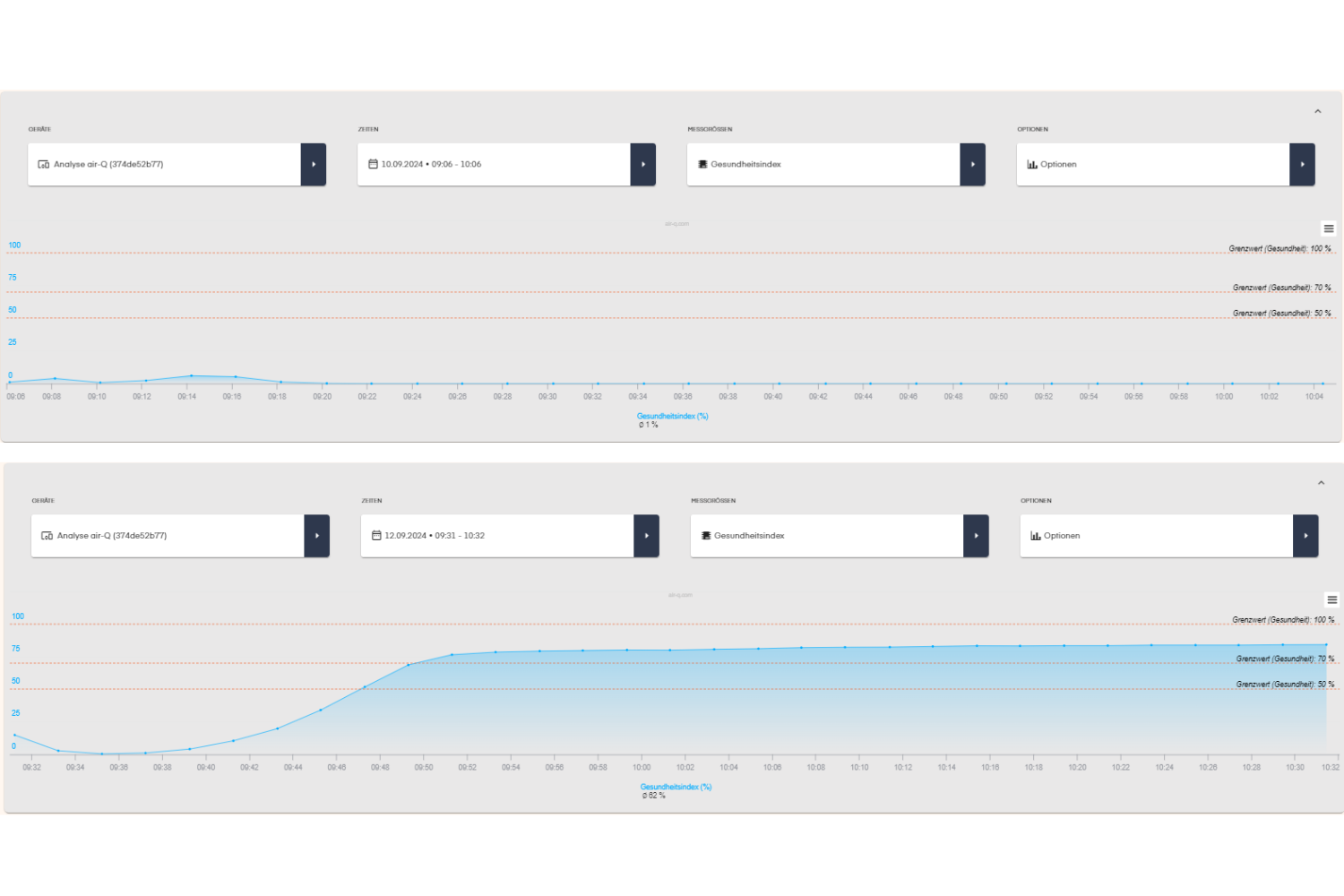
During the first test run without the air filter, the health index averaged 1%. The thresholds of 50, 70, and 100% were therefore never reached. Only at 9:08 a.m. and between 9:12 and 9:18 did the index rise briefly – reaching only marginal values of around 5%.
The second test run with the air purifier, by contrast, showed a clear increase in the health index. While a poor index at a 0% line was likewise recorded at the start of the test, the value rose steadily as pollutants were reduced. In line with the decrease in particulate matter and VOC pollution, the health index rose steadily after about 15 minutes into the test. Already after 16 minutes, the index reached the first threshold of 50%, then 70% after another 2 minutes. The value then leveled off at around 80% and stayed at that level until the end of the test. With the air purifier, an average health index of 62% was achieved.
air-Q test: effect of the Blueair Classic 680i air purifier on air quality: results & analysis
The comparison of the two test series shows the clear effectiveness of the Blueair Classic 680i in reducing particulate matter and VOCs. Without the air purifier, it took almost six hours for the PM₁₀ threshold of 40 µg/m³ to be undercut. With the air purifier, this value was reached in less than 10 minutes. After one hour, particulate matter pollution had even dropped completely to 0 µg/m³.
The difference was also significant for volatile organic compounds. Without the air purifier, the VOC value never fell below 2000 ppb over the entire day, staying well above the threshold of 1200 ppb. With the air purifier, on the other hand, the threshold was clearly undercut after just one hour, and VOC pollution dropped to 221 ppb.
Spontaneous use of the Blueair Classic 680i uncovers particulate matter pollution in the air-Q office
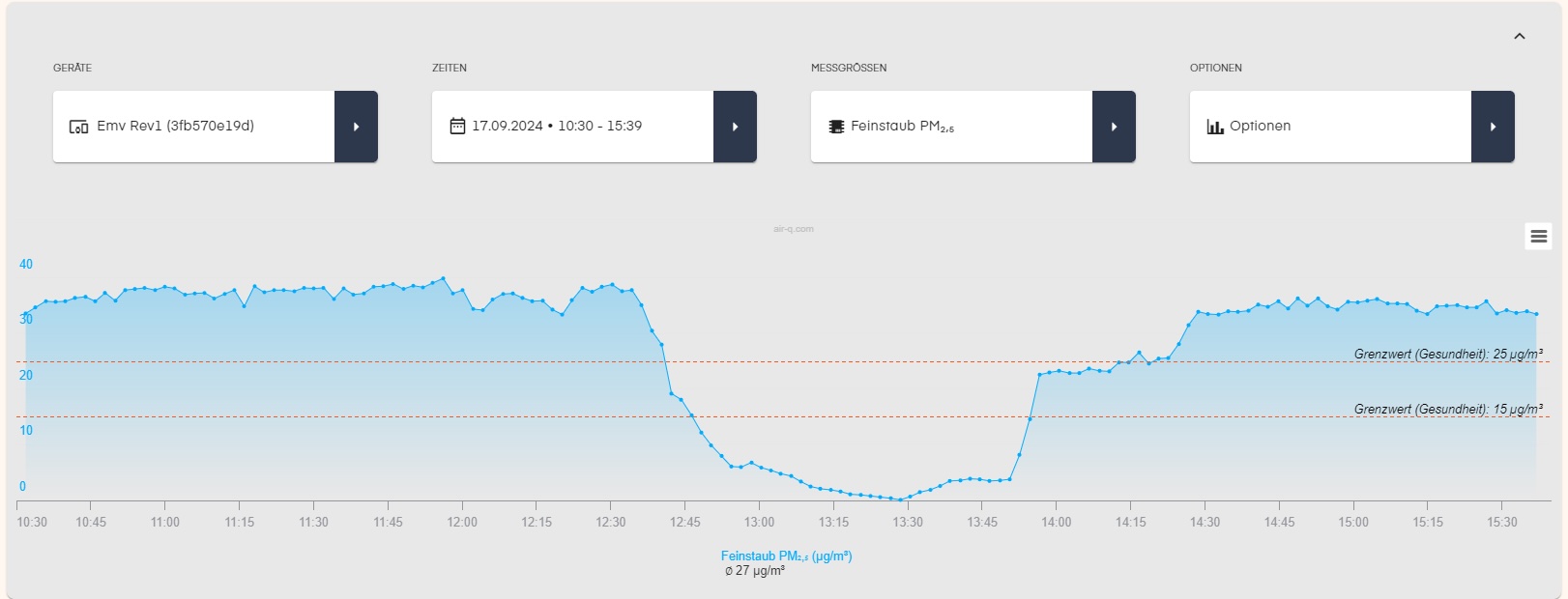
A few days after our hands-on test, another random real-world test came up by chance. Although we hadn't noticed or smelled anything, particulate matter levels were sharply elevated due to construction work in front of the building. Only a glance at the air-Q showed that thresholds were being clearly exceeded. The air-Q recorded particulate matter pollution above 30 µg/m³ between 10:30 a.m. and 12:30 p.m. and again between 2:00 and 3:30 p.m. In the meantime, pollution dropped rapidly to 0 µg/m³. That's because we had the air purifier running during our lunch break, and it had filtered the particulate matter out of the room air. After the lunch break, we switched off the Blueair Classic 680i and reopened the windows, letting construction dust back into the room.
Conclusions about how the air purifier works, plus usage recommendations
In this experiment, the Blueair Classic 680i air purifier showed very high efficiency both in removing particulate matter and in eliminating volatile organic compounds. We were especially surprised by how quickly the purifier removed particulate matter from the air. The reduction in VOC values was also significant and markedly faster than without the device.
Allergy sufferers in particular benefit from rapid air purification. Pollen attaches to particulate matter, which increases the burden on allergy sufferers. Removing dust therefore helps you relax at home and sleep more soundly. The air purifier is also well suited to homes or workplaces on busy streets, to raise air quality.
The Blueair Classic 680i is thus ideal not only for allergy sufferers but also for everyday use in polluted indoor spaces. Especially in rooms where pollutants such as particulate matter or VOCs regularly arise, for example from cooking, smoking, or using fragrances, this air purifier could make a valuable contribution to improving air quality. The air purifier is also helpful for offices. Thanks to its fast performance, it's well suited to targeted use during a lunch break.
For optimal air quality: combining air measurement & air purification
The interplay of an air purifier and an air monitor proves highly effective for continuously monitoring air quality and intervening in a targeted way as needed. The air purifier provides a fast, lasting reduction in pollutants, while the air-Q measures particulate matter and VOC readings in real time, enabling immediate control of air quality. Beyond that, the air-Q also measures many other pollutants, such as CO₂, CO, humidity, air temperature, and many other parameters, giving you a comprehensive view of your room air composition. Thanks to these precise measurements, you can take targeted action as soon as room air pollution rises. This makes a substantial contribution to a healthier indoor climate.
Discover our various air-Q models and your options for breathing easy and healthy.