
Getting to the Bottom of Odors and Indoor Climate Problems With the air-Q Indoor Air Analysis — for Your Health
The quality of your indoor air affects your well-being. That's why you should know what's in the air. An indoor air analysis is effective for detecting mold early and identifying air pollutants that harm health. You'll also learn which measures you should take to improve air quality.
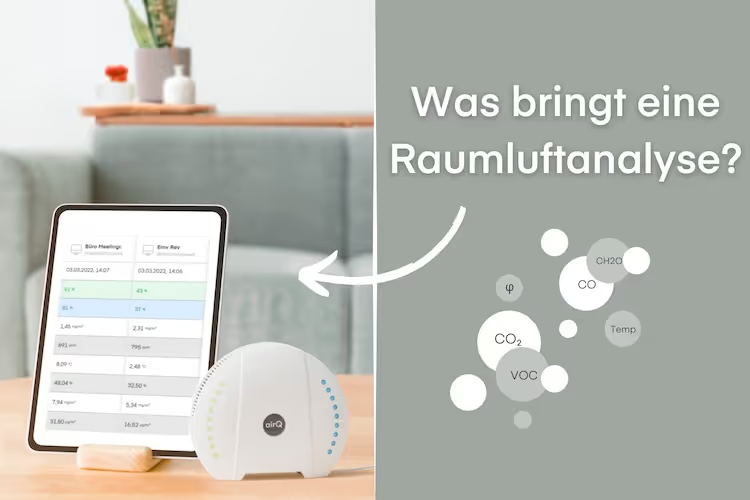
1. Air analysis for a comprehensive understanding of air composition
The air contains a wide range of pollutants, which also enter the body through breathing, potentially causing health impairments and a wide range of symptoms. Poor air shows up through many symptoms: from headaches, poor concentration, and respiratory problems to effects on the cardiovascular system.
An analysis of room air detects the air's components and can help identify potentially harmful substances in the air. From excess humidity to toxic gases and pollutants like formaldehyde, to general air pollutants — an air analysis provides a comprehensive picture of the air quality in your home. Early detection of such pollutants helps avoid health problems, especially for people with respiratory problems or allergies. It also uncovers behavioral patterns like improper ventilation and helps you identify and eliminate sources of danger.
Good indoor air quality is also crucial for employee well-being and productivity in work environments. Here too, an indoor air analysis can help ensure that no harmful substances are present that could affect employee health. Alternatively, you can also use our air-Q indoor climate monitor to keep an eye on the most important parameters at all times.
2. How the air-Q indoor air analysis works
You can carry out an indoor air analysis with air-Q. For your analysis, you receive one of our air-Q pro measuring devices; on request, we also send you the device with special equipment — meaning special sensors. With a wide range of sensors, the air-Q detects the air's components, analyzes the indoor climate, and detects environmental influences with scientific precision. The air quality monitor records all data in real time. In just 3 steps, you get your professional air analysis.
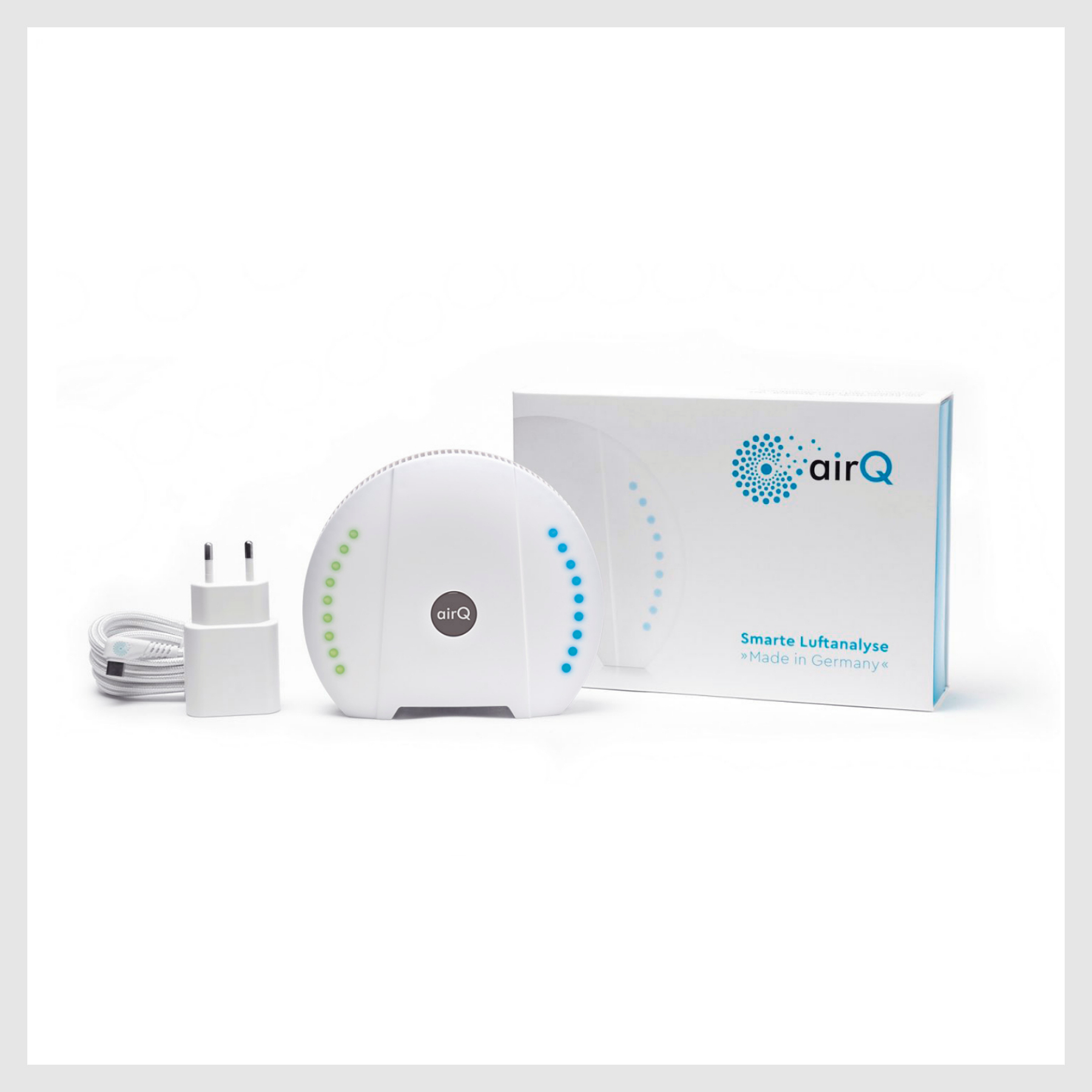
Receive & set up the test device
You receive the air-Q pro including 14 sensors for a one-week trial period. After unpacking it, all you need to do is plug the analysis device into a power outlet via cable, and you can start analyzing your room air right away.
Trial period
With the device, you receive login credentials for free access to the air-Q's live data via the smartphone app and web app. Using various charts, you can read off the air's composition and how its components are developing. On the device itself, two LED displays illustrate the current air quality of two selected air components. The colored traffic-light display shows you whether the level of the air component is within the recommended limit values or requires action on your part.
Professional data evaluation of the air analysis
After the trial period, we have all the measurement results, and one of our air experts individually evaluates your data. You then receive a clear summary of your data, including detailed explanations. The analysis also includes information on the measured pollutant exposure as a compact, informative report of about 3 to 5 pages. It also includes all important charts of readings as well as tips for a better indoor climate.
3. Keeping an eye on dangerous air pollutants
The air-Q pro enables an indoor air analysis using 14 different sensors. This lets you monitor a wide range of pollutants: particulate matter (PM₁ – PM₂.₅ – PM₁₀), carbon dioxide (CO₂), oxygen (O₂), sulfur dioxide (SO₂), volatile organic compounds (VOC), nitrogen dioxide (NO₂), carbon monoxide (CO), ozone (O₃), hydrogen sulfide (H₂S), relative & absolute humidity, temperature (T), dew point (Td), air pressure (p), noise (Lp).
4. Improving room air – individual tips from an air expert
An indoor air analysis not only uncovers pollutants in the air and problematic behavioral patterns, it also helps you avoid them in the future. Our experience shows that every "air problem" should be solved individually. Still, we can give you a few general tips for improving air quality.
- Ventilate regularly: adjust your ventilation behavior to the current air quality.
- Use air purifiers: use air purifiers with HEPA filters to remove particles like dust, allergens, and pollutants from the air.
- Add plants: houseplants can help improve air quality by absorbing pollutants and producing oxygen. We measured how plants affect air quality. You'll find the results of our experiment in our separate post.
- Identify & eliminate sources of pollutants: regular monitoring of room air with an air quality monitor is advisable to identify sources of pollutants.
- Control humidity: is your room air too dry or too humid? Keep humidity in a reasonable range, ideally between 30 and 50 percent. If there's too much moisture in the room air, this can promote mold growth. An indoor air analysis for mold currently works by evaluating absolute and relative humidity as well as oxygen content in the air. Accordingly, indicators are used for a room air mold test whose presence favors mold growth. Humidity that's too low, on the other hand, can lead to overly dry air, which can cause breathing difficulties. Humidifiers or dehumidifiers provide relief when needed.
- Regular cleaning: vacuuming and dusting reduces the concentration of allergens and dust particles.
5. Cost & benefit in focus
Invest in your health and weigh the cost of an indoor air analysis against the long-term health benefits. A self-test indoor air analysis is also a preventive measure. By detecting air pollutants early, you can act accordingly and thus avoid long-term costs, for example construction work due to mold. You'll find more information on the air-Q indoor air analysis here.