
air-Q Founder Mario Körösi Answers Customer Questions
We've been offering the air-Q for several years now. A lot has changed since launch. Time to ask: what do people like, and what don't they? In a survey through our newsletter, we wanted to find out which topics matter to our customers and people interested in air quality, what they wish for, and where there's room for improvement.

air-Q founder and CEO Mario Körösi answers the collected customer questions in the following interview and gives an outlook on upcoming developments. This covers questions about product features, desired sensors, functions, and solutions for air quality problems. Find out directly from the boss how things are progressing with the air-Q and what's planned.
Mario Körösi: First of all, I have to thank everyone who took part. We're delighted by the enthusiastic participation of our customers in the survey. It gave us some fascinating insights. There were also a lot of great ideas that we would never have come up with on our own, and that help us tailor the air-Q even better to your wishes. Below, I'll go through a selection of the questions that came up in the survey.
Question: For customers who already own an air-Q: which sensors were especially interesting to you when making your purchase?
Mario Körösi: When it comes to purchase-deciding sensors, there's a clear ranking. Our nitrogen dioxide sensor is of interest to the most customers. Many individual sensors were mentioned in the comments, which are listed under "Other" in the chart.
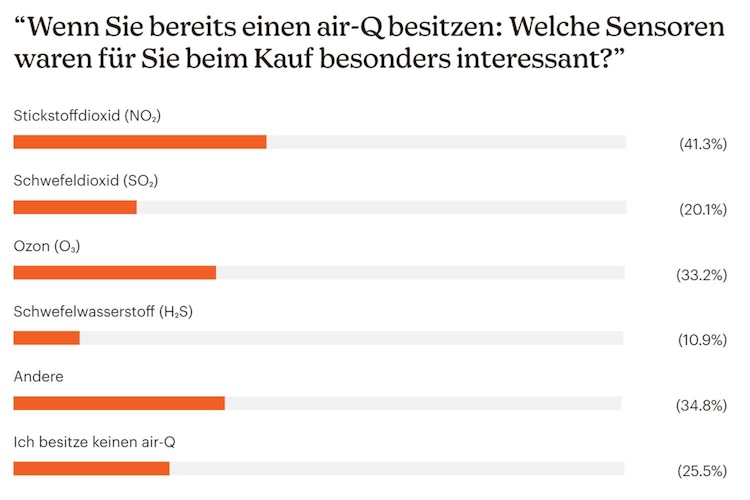
We've adjusted the base configuration of the various air-Q models somewhat over time, which skews the results a little for the pre-set answer options.
Of course, we'd love to learn more here and invite everyone to share their wishes with us. The air-Q is extremely flexible and can be upgraded with virtually any conceivable sensor. If interest in a particular sensor is especially strong, there's nothing stopping us from integrating it into a pre-configured air-Q model.
Question: Which additional sensors would customers like to see in the air-Q?
Mario Körösi: There's a clear trend here: 82 % would like a sensor that detects the carcinogenic solvent formaldehyde in the surrounding air and warns about it. Also of interest is methane, the main component of heating gas, and ammonia, which often occurs in connection with fertilizers and factory farming.
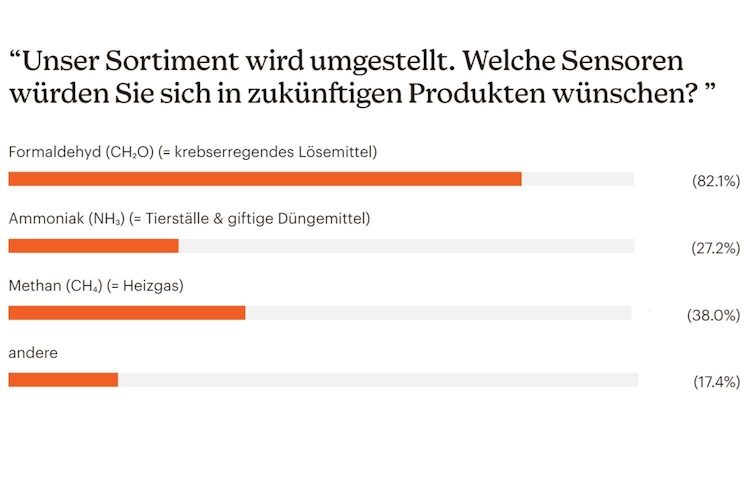
In response to the survey, we were able to offer the air-Q basic formaldehyde as a short-term promotional product by the end of the year, and we're currently planning to add it to our regular product range once the promotional period ends.
Question: Will the air-Q get sensors for radon and ultrafine particulate matter, and if so, what's the current development status?
Mario Körösi: Our standard particulate matter sensor can already measure particles under 1 µg in addition to PM10 and PM2.5 – including ultrafine particulate matter. However, the sensor doesn't output ultrafine particulate values separately; it sums this load under the PM1 reading in µg/m³. We're therefore planning to offer an additional particulate matter sensor for upgrading the air-Q soon. This one will then also be able to capture and output ultrafine particulate values (PM 0.1).
The air-Q radon, as the name suggests, can measure the radioactive gas radon. For this, we've developed our own radon sensor module, which is significantly cheaper and at least as good as alternative products. Together with our electronics and software, we'll be offering by far the best radon detector on the market.
Question: Will there be an air-Q that only measures CO₂ and is therefore cheaper?
Mario Körösi: We build high-end air quality monitors that offer more functions than a classic CO₂ traffic-light monitor and are also designed for broader use cases. Our software (app/firmware) in particular, along with the highly developed hardware and powerful microcontrollers, are very costly to develop and manufacture (in Germany). Only this makes features like push notifications, high measurement frequency, upgradability and so on possible in the first place. That said, we do offer the air-Q light as an affordable entry-level product, which also has a carbon dioxide sensor.
Question: Does the air-Q offer the option to configure the sensors yourself and add more later on?
Mario Körösi: Yes, the air-Q basic can be expanded with 4 additional sensors. The air-Q pro and science models are also expandable. Many customers already take advantage of the option to expand the air-Q basic themselves and put together their own individual monitor. This option is somewhat hidden in the shop, since we don't want to confuse customers here. In theory, there are several thousand possible sensor combinations for an air-Q.
Question: Will there be an all-in-one device with radon and all the air-Q's sensors?
Mario Körösi: Our upcoming radon monitor will also include CO₂, VOC, humidity, temperature, and air pressure. The air-Q radon
focuses on radon, though, and won't include electrochemical sensors (NO2, SO2, H2S, etc.). Otherwise, the device would end up very large and quite expensive.
Question: How can the air-Q detect cigarette smoke?
Mario Körösi: The air-Q can measure many of the components of cigarette smoke. These are VOC, particulate matter, nitrogen oxides, carbon monoxide, and formaldehyde. You can set the alarms (visual, acoustic, or push) in the air-Q so that an alarm is triggered when limits are exceeded. The special, pre-configured "cigarette smoke alarm" will soon be selectable under "Smart Alarms" in the air-Q app.
Question: Will there also be sensors to detect or distinguish between tobacco smoke and cannabis smoke, as well as pollutants from e-cigarettes?
Mario Körösi: Distinguishing between cigarette smoke and cannabis smoke likely won't be possible in the future either. However, we're currently working on a cigarette smoke alarm. We've already tested the effects of e-cigarettes on air quality. You can read the results in our article on the topic "Vaping Indoors".
Question: Will it be possible in the future to detect mold spores in indoor air with the air-Q?
Mario Körösi: We're working on a mold alarm that analyzes values like humidity, temperature, and heating behavior to give advance warning of mold. Unfortunately, no measuring device can currently measure and reliably detect mold spores themselves. Mold is, in part (but only in part), particulate matter. This, in turn, can have many sources, and it's currently not possible to classify it beyond particle size.
That said, we're already working with TU Chemnitz on a joint research project developing an advanced particulate sensor that can also distinguish particles by type. Our vision here is to also be able to distinguish mold spores (from pollen and other industrial particulates). But there's still quite a long way to go to reach that goal.
Question: Can the air-Q detect electromagnetic radiation or electrosmog?
Mario Körösi: We've already run a few experiments on this topic. So far, though, we don't yet have a perfect solution for measuring it.
Question: How can the actual causes of things like NO₂ or particulate matter and other readings be better determined?
Mario Körösi: We love this topic! We're working on it, but it's very complex. In part, we already offer this (for example with the planned cigarette smoke alarm or in the indoor air analysis). We're also working on a virtual, AI-based health advisor that will increasingly recognize correlations on its own in the future. Stay tuned!
Question: When will air-Q deliver the long-promised Matter support?
Mario Körösi: We're in the final stretch. This standard is very demanding, and we're working to integrate Matter by spring 2024.
Question: Can air-Q pro & science be borrowed for, say, a week or a month for an indoor air analysis?
Mario Körösi: Yes, that's possible. We've been offering an air analysis service for some time. Alongside the written evaluation, the analysis also includes a phone call where all questions can be clarified. We're also open to fully individual requests here.
Question: Will there be an air-Q with a built-in display?
Mario Körösi: A display would certainly be nice, but it would make the air-Q considerably more expensive. We've kept the air-Q's design very minimal, in order to focus entirely on the high-quality sensors and the smart app. In theory, though, you could display your own readings via our Smart Widgets on a website or in a presentation. Then you wouldn't need a display on the air-Q itself.
Question: Will there be an air-Q with a battery?
Mario Körösi: Every air-Q can also be run on a power bank. Our special edition already includes a suitable power bank and table stand for exactly this purpose. This turns it into a smart, mobile security helper for things like travel, vacation homes, or RVs.
Question: The air-Q often falls over or stands unsteadily.
Mario Körösi: Because of our especially sturdy and long cable, the air-Q's stability does suffer a bit if the device or the cable is moved. We're aware of this issue, which is why we recently introduced the table stand for the air-Q, which provides a stable footing even when the air-Q changes location often.
Question: Are there adjustable alarm tones, warning sounds, or special sounds for individual air pollutants? Is it even possible to upload your own sounds?
Mario Körösi: With the air-Q science, this would actually already be possible! The API gives you access to all of the air-Q's functions, so you can program your own sounds. That requires a bit of technical expertise, but it's doable with our help. Unfortunately, we can't integrate this into the standard series.
Question: Will there be an air-Q for outdoor use? There are so many sensors in the air-Q - is some kind of air quality map planned? Products like AirVisual from IQAir offer this feature.
Mario Körösi: The air-Q is an indoor air quality monitor. The electrochemical sensors react very sensitively to humidity and temperature fluctuations and can lose their calibration outdoors. To conduct outdoor measurements properly, you'd need to climate-control an outdoor monitoring device. This raises the question of how reliable existing maps actually are – unless the values come from official measuring stations run by the Federal Environment Agency, which operate appropriately climate-controlled stations.
What we could show, however, is what the air is like in German bedrooms. Wouldn't that be interesting? There's already a project for this; it just needs volunteers. If you'd like to measure the air quality in your room sometime and share the data with others, feel free to join our "Alliance for Good Air Quality in the Bedroom".
air-Q: Thank you for the interview and the fascinating insights.
Mario Körösi: Thank you for the extensive participation and the positive feedback! Our team is also very grateful for suggestions and constructive criticism, since that's the only way we can improve and develop new, customer-focused functions and features.